
Why Piping Design and HVAC Skills Are Among the Most In-Demand Technical Careers in India
Enquiry Now
The engineering industry in India is evolving, really fast, which is bringing really interesting
career openings for both students and people already working. Sectors like oil & gas,
construction, manufacturing, pharmaceuticals and infrastructure keep on needing capable
people who can plan, install, and keep running important engineering systems, day to day.
Some of the quicker technical career directions include piping design engineering and HVAC
(Heating, Ventilation, and Air Conditioning). These areas usually give stable employment and
solid pay, and you can end up working on big industrial, plus commercial, projects too.
If you’re thinking about a technical career, looking into these industries first can help you
choose better for your upcoming years.
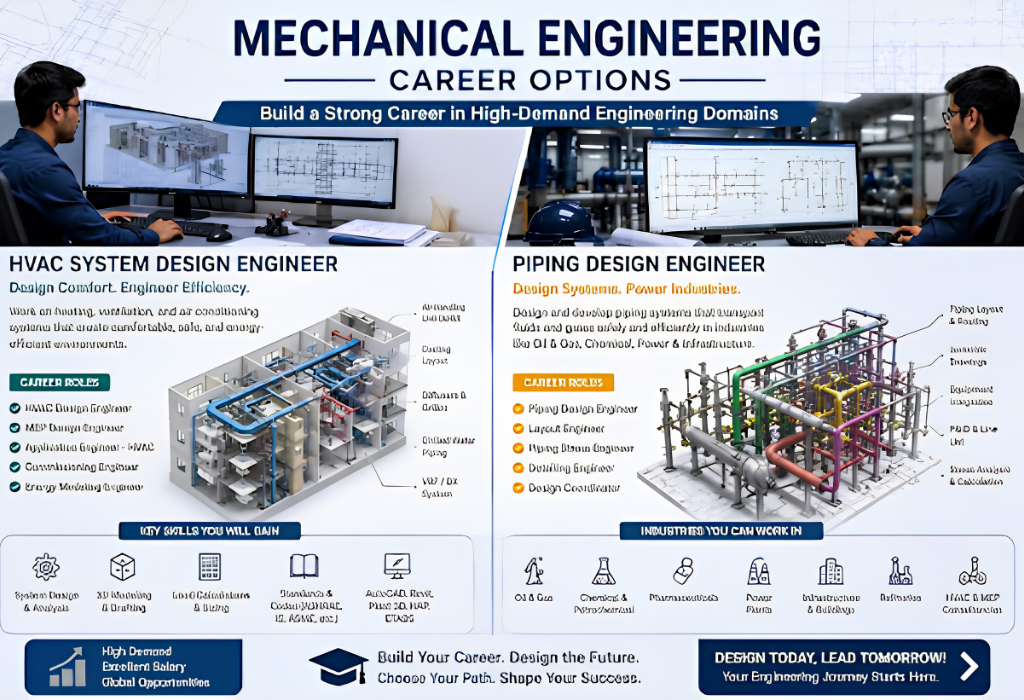
What Is Piping Design Engineering?
Piping design
engineering is basically about planning and building piping systems that
move liquids, gases, chemicals, steam and other materials safely inside industrial sites. A
refinery, a power plant, a chemical factory, a pharmaceutical unit, and even a processing line—
all of them depend on piping that was designed in a careful way so the operations stay efficient.
A person in piping design typically does things like:
- Making piping layouts and routing paths
- Preparing isometric drawings for fabrication and checking
- Choosing the right piping materials
- Working strictly with international engineering codes and standards
- Coordinating with civil, mechanical, and structural teams
- Assisting plant design as well as maintenance projects
As industries keep expanding, the need for people who complete a Piping Design Course, or a
Piping Engineering Course, keeps rising.
Why Mechanical Engineers Choose Piping Design
A lot of mechanical engineering graduates move past the usual manufacturing track to find more specialized work. A Piping Design Engineering Course gives skills that are very directly usable in areas such as:
- Oil & gas
- Petrochemicals
- Power generation
- Water treatment
- Food processing
- Pharmaceutical manufacturing
- EPC (Engineering, Procurement, and Construction)
These sectors often hire piping engineers because an industrial plant simply cannot run
smoothly without well-designed piping networks, connecting everything the right way.
Skills You Learn in a Piping Engineering Course
A quality Piping Engineer Course kind of balances core engineering know-how with practical
stuff, and yes it matters a lot. Students usually learn concepts around plant layout and pipes
routing, plus they go through piping materials, valves and fittings, industrial standards too.
Along with that they often cover equipment layout, engineering drawings, design
documentation, and safety requirements too, not just theory.
Many professionals also decide on a PG Diploma in Piping Design Engineering or go for a
Piping Design Course with Placement. The
idea is to boost their career path and get that real
industry exposure, sooner rather than later.
The Growing Importance of HVAC Professionals
One more area that is seeing very strong demand is HVAC and refrigeration. Residential
buildings, shopping malls, hospitals, hotels, offices, and factories keep expanding, so skilled
HVAC
technicians and engineers are becoming more and more valuable.
Modern air conditioning systems are now made for more than comfort, they also focus on
energy efficiency, indoor air quality, and environmental sustainability. Because of that, the
demand has gone up for people who complete an AC Mechanic Course, or even an HVAC
Engineer Course.
What Does an HVAC Technician Do?
HVAC professionals handle installing, maintaining, inspecting, and repairing air conditioning
and refrigeration systems. Basically, they help cooling systems run smoothly and efficiently,
without wasting energy too much.
Typical responsibilities look like this:
- Installing air conditioners
- Finding and diagnosing system faults
- Refrigerant charging
- Preventive maintenance work
- Electrical testing
- Compressor servicing
- Indoor and outdoor unit maintenance
People searching for an AC Technician Course, Air Conditioner Course, or Air Conditioning
Technician Course often prefer training programs that give hands-on practice with modern
equipment. That’s where the learning feels real, not just memorized.
Why Practical Training Matters
Technical careers need more than bookish understanding. Employers usually want candidates
who already grasp industry tools, safety steps, and how things work in real environments.
Hands-on learning can help students:
- Develop technical confidence
- Upgrade troubleshooting abilities
- Understand industrial workflow rhythms
- Get ready for interviews
- Adjust quickly to workplace environments
So, many aspiring engineers look for institutes that mix classroom teaching with practical lab
time, kind of like theory followed by action, back to back.
Choosing the Right Technical Institute
Picking a training institute is one of those decisions that can actually shape your future. While
comparing options, students should check things like updated curriculum, practical training
facilities, experienced faculty, and industry-oriented teaching methods. Placement assistance
also matters, and student support services too, because you never know what help you might
need.
Among the institutes offering technical education, Suvidya Institute of Technology Pvt. Ltd. has
become a known option for career-oriented programs in engineering and technical training.
Students searching for Suvidya Institute of Technology Mumbai, or looking for info about
Suvidya Institute of Technology Pune, often explore its programs since the focus stays on
practical learning and industry-relevant skills.
Career Opportunities After Technical Training
When you finish a specialized technical course, you may open doors across different industries. The exact path depends on your specialization, but professionals can often find opportunities in:
- Engineering consulting firms
- Oil & Gas companies
- Power plants
- HVAC contractors
- Construction companies
- Manufacturing industries
- Facility management organizations
- Pharmaceutical companies
- Infrastructure projects
Possible job roles may include:
- Piping Design Engineer
- Piping Engineer
- HVAC Engineer
- AC Technician
- Refrigeration Technician
- Maintenance Engineer
- Project Engineer
- Design Engineer
And as India’s industrial sector keeps growing, the demand for skilled technical professionals is
expected to stay strong, even in the coming years.
Final Thoughts
A strong technical career starts with learning the right skills and understanding what the
industry actually expects. Whether you’re leaning toward plant engineering via a Piping Design
Course, or you’re more interested in building services through an AC Mechanic Course, choosing
training that is practical and industry-focused can really change the outcome.
Institutes like Suvidya Institute of Technology Pvt. Ltd. play a part in that journey, by offering
programs that highlight hands-on learning, technical knowledge, and career readiness. With
continuing expansion in infrastructure, manufacturing, and energy sectors, professionals
trained in piping
engineering and HVAC are generally set up for long-term career
opportunities.


