
What is HVAC? Complete Beginner’s Guide
Enquiry Now
Heating, Ventilation, and Air Conditioning, commonly known as HVAC, is kinda one of the most important technologies used in today’s residential, commercial, and industrial buildings. Like, whether you’re just sitting in a comfortable office during summer, or you’re working in a hospital where the indoor air quality is kept under control, or even shopping in a mall where the temperatures stay pretty steady, you can bet an HVAC system is working in the background to make the space safe and comfortable.
And as cities keep expanding, plus buildings getting smarter, and more energy efficient every year, the need for skilled HVAC specialists has really gone up. Construction folks, manufacturing teams, pharmaceutical facilities, healthcare centers, hospitality operators, and commercial real estate owners all lean on well designed HVAC systems. Because of that, more students and working professionals end up searching for hvac courses near me, so they can learn hands on know how and build good careers in this fast growing field.
If you’re thinking about a career in mechanical engineering, building services, or facility management, learning the basics of HVAC is really a great starting point.
What Does HVAC Stand For?
HVAC stands for Heating, Ventilation, and Air Conditioning. these three parts work side by side to manage indoor temperature, humidity, air movement, and air quality inside a building.
The heating part keeps indoor rooms warm in colder seasons, by creating and distributing heat efficiently. Depending on the building’s needs, heating might be done using boilers, furnaces, heat pumps, or electric heating setups.
Ventilation is mostly about keeping a healthy indoor air quality. It takes out stagnant air, odors, smoke, dust particles, and other airborne nasties while also bringing in fresh outdoor air. If ventilation is done right, it helps stop pollutants from piling up, and it helps people breathe cleaner air.
Air conditioning handles cooling, by pulling out extra heat and humidity from inside spaces. It’s not only about comfort though, air conditioning also helps safeguard sensitive equipment, protects materials, and supports the right climate for hospitals, laboratories, data centers, and manufacturing operations.
Together, these three components build an indoor atmosphere that feels comfortable, stays healthy, and uses energy in a more efficient way, no matter what the weather is doing outside.
Why HVAC Systems Are Important
Modern buildings are now designed with occupant comfort, energy efficiency, and sustainability in mind. HVAC systems help a lot in meeting those goals, mostly by keeping indoor temperatures stable through the entire year.
But it’s not just comfort. HVAC systems also affect health and productivity in a real way. Good ventilation lowers indoor pollutants, allergens, bacteria, and too much moisture. So, people end up living and working in healthier conditions. In offices, stable temperatures can support productivity, while hospitals depend on advanced HVAC systems to keep environments sterile, and also to reduce the spread of airborne infections.
Industrial sites are another story, they heavily rely on HVAC technology too. Manufacturing plants need consistent temperatures to protect product quality. Pharmaceutical companies often require cleanroom conditions, and food processing places depend on refrigeration plus climate control, to keep products safe and fresh.
Since more people are thinking about energy conservation, today’s HVAC systems are getting smarter, often using automation, IoT integration, and energy saving technologies. Engineers are now focused on designing systems that give maximum comfort while also cutting electricity use and lowering environmental impact.
How Does an HVAC System Work?
Even though HVAC systems can look different depending on the building and its purpose, most of them follow the same core idea: controlling indoor environmental conditions by managing temperature, airflow, humidity, and air quality.
It usually starts with sensing indoor temperature through a thermostat. When the indoor environment drifts away from the desired temperature, the thermostat triggers the heating or cooling equipment.
During cooling, refrigerant travels between the indoor and outdoor units, absorbing heat from inside the building and then pushing that heat outside. Fans and ductwork move the cooled air through the rooms so that comfort stays fairly consistent.
During heating, the system produces warm air or hot water, based on what type of equipment is installed. Then that heat is carried through ducts, radiators, or sometimes underfloor heating systems.
Ventilation keeps exchanging indoor and outdoor air, while filtering out contaminants. Air filters catch dust, pollen, and other particles before the conditioned air returns to occupied spaces.
Humidity management is also a big deal. Too much moisture can lead to mold growth, while overly dry air can cause discomfort. Modern HVAC systems aim to maintain balanced humidity levels, so comfort stays high and indoor air quality stays better.
Major parts of an HVAC system
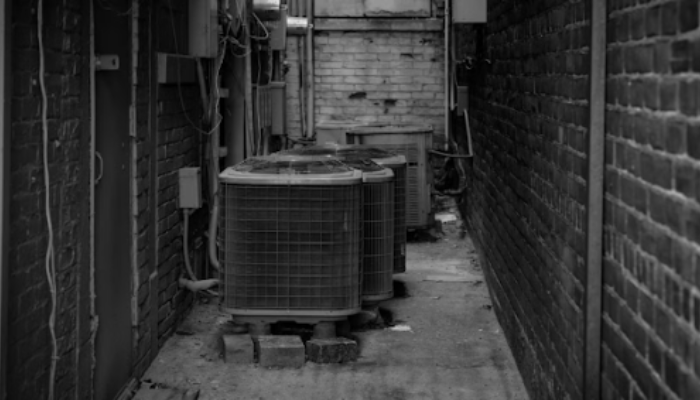
An HVAC system is made up of several linked components that kind of work together to deliver, efficient climate control. It’s not just one machine, but a set of parts coordinating so the indoor environment stays stable
The thermostat is basically the control center. It keeps an eye on indoor temperatures and it automatically fine-tunes heating or cooling actions, so the desired settings stay consistent.
Then there’s the compressor, which people often call the heart of an air conditioning system. It compresses refrigerant gas, so heat transfer can happen more effectively during the cooling stage
The evaporator coil takes in heat from the indoor air , while the condenser coil releases that heat outside. Together, these two coils finish off the refrigeration process that makes cooling possible
Air handling units and blowers help circulate the conditioned air around the building, usually through ductwork . Good airflow matters a lot because every room should get adequate heating or cooling, without weird hot and cold spots
Air filters are also important . They remove dust, allergens , and other airborne contaminants before the air is recirculated again. If filters aren’t maintained regularly, system efficiency drops and indoor air quality can suffer too
Duct systems then move heated or cooled air to different sections of the building. When ductwork is designed well, it reduces energy loss, and keeps airflow balanced , which improves comfort and performance
Each component needs careful selection and proper engineering based on building size, how many people use it, the local climate , and the energy needs. That is why trained HVAC professionals are in high demand across construction, and engineering industries
Why learn HVAC?
The HVAC sector can be a strong career track for students who like engineering, construction, and building services. Since new commercial projects keep coming up like hospitals, hotels, malls, and industrial facilities, skilled HVAC professionals stay in demand for designing, installing, operating, and maintaining these systems
A lot of aspiring engineers start by searching for hvac courses near me, often to find options that mix theory with real industry experience. Proper HVAC education covers heating and cooling basics , refrigeration cycles, duct design, load calculations, ventilation requirements, energy efficiency, and even the industry software used in modern system design
And if students want a practical path forward, the Air Conditioning System Design (HVAC) program at Suvidya Institute gives industry-focused training meant to prepare learners for real engineering situations. The program emphasizes hands-on applications, modern HVAC technologies, and job-relevant skills that employers look for across different industries.
Types of HVAC systems
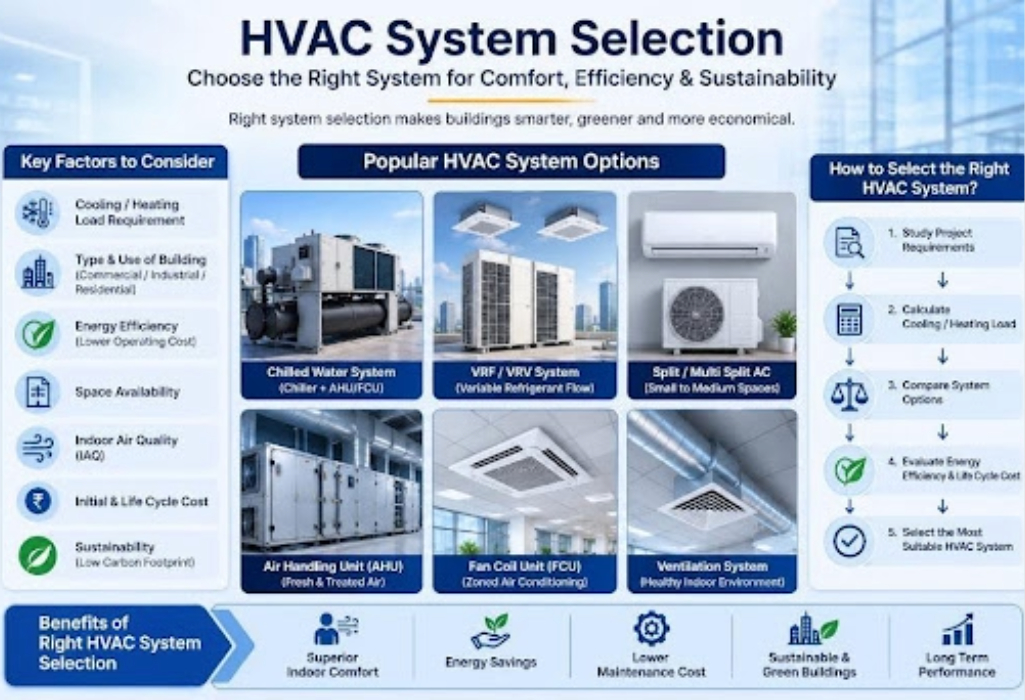
HVAC systems come in a few different setups , depending on how big the building is, who uses it, the climate outside , and what the owners actually need to run day to day. Picking the “right” system is basically one of the main jobs for an HVAC designer, because each project has its own heating, cooling , and airflow needs and it’s never exactly the same.
Split systems are, like, some of the most common things installed in homes and smaller commercial places. They have an indoor unit and an outdoor unit that work together so the inside stays comfy. People like them because they’re usually not too expensive, they’re easy to service, and they can be pretty energy smart for smaller layouts.
Packaged HVAC systems put the big parts into one single unit. You see these a lot in commercial buildings where there’s not much indoor space to work with. They make installation simpler and they tend to run reliably in medium sized facilities.
Central HVAC systems are made for larger buildings, think shopping malls, hospitals, airports, hotels, big office buildings , and schools. They send conditioned air across many floors and rooms using large duct systems. This centralized approach can keep comfort more consistent, while building managers can still watch and manage indoor environmental conditions without too much hassle.
Variable Refrigerant Flow (VRF) and Variable Refrigerant Volume (VRV) systems are getting more common in newer commercial builds . These newer designs change refrigerant delivery based on what each zone needs for cooling or heating, which can mean real energy savings and better comfort for occupants. Because they’re so adaptable, they often fit office buildings , hotels, and higher-end residential projects where comfort control matters.
Industrial HVAC systems are designed for harder-use spaces like factories, pharmaceutical sites, labs, clean rooms, food processing areas, and manufacturing lines. In these environments temperature, humidity, air pressure, and air quality have to be controlled very precisely to keep production on track and meet regulatory expectations.
When engineers understand the benefits and use cases of different HVAC systems , they can recommend options that balance performance, energy efficiency , installation expenses, and how dependable everything will be long-term.
The Importance of HVAC Design
Putting HVAC equipment in place is just one piece of building a climate control setup that actually works. Before any unit is picked, engineers need to design the whole system so it matches what the building requires.
HVAC design starts by looking at the building’s shape and layout, its orientation, how people will occupy it, insulation levels, lighting , and the local weather. All these items affect the heating and cooling load calculations that end up determining the HVAC equipment size and capacity.
Doing load calculations correctly helps avoid common headaches like equipment that’s too big or too small. Oversized systems can chill a space too fast, so humidity control gets worse and the room feels “off.” Undersized systems, on the other hand, may not keep up during the hottest or coldest periods, meaning comfort drops when conditions peak. Accurate calculations can improve comfort, lower energy use , and also help equipment last longer.
Engineers also map duct routes so conditioned air spreads evenly across the building. If duct design is poor, you can get pressure losses , uneven airflow, higher operating costs , and an indoor environment that feels uncomfortable. Each duct segment, diffuser, grille , and return air route has to be planned carefully to keep airflow balanced.
Ventilation planning is another major part of HVAC design . Fresh outdoor air has to come in, and stale indoor air has to be removed to keep air quality healthy. Engineers also need to follow building codes and ventilation standards so occupancy stays safe.
Energy efficiency is now a top priority in HVAC design. Many modern buildings use energy recovery units, high efficiency chillers, smart controls, occupancy sensing, and automation systems to cut operating costs and still support sustainability targets.
Students in professional HVAC programs usually build real understanding of these design ideas through hands-on projects and industry tools, including the software used in practice. That experience helps prepare them for engineering careers across different sectors.
Skills Required to Become an HVAC Professional
The HVAC industry blends engineering knowledge with real-world problem-solving. Good professionals understand mechanical systems, but they also develop analytical thinking and stay attentive to details that other people might overlook.
A strong base in thermodynamics, refrigeration basics, heat transfer, fluid mechanics , and ventilation concepts gives the technical backbone for HVAC engineering. On top of that, professionals must interpret engineering drawings, carry out load calculations, and understand how building services get integrated into the overall system.
Computer-aided design software is now pretty much required in HVAC engineering. Most modern engineers use tools like AutoCAD , Revit MEP, and dedicated HVAC design platforms to build layouts, equipment lists, and ducting plans.
Communication skills matter just as much, because HVAC engineers team up with architects, structural engineers, electrical consultants , contractors, and project managers. When multiple disciplines are coordinated well, HVAC systems fit into the full building design without awkward gaps or delays.
Continuous learning drives career growth too. Since energy efficient technologies, green building approaches, automation setups, and smart infrastructure are always changing, HVAC professionals have to stay current with new industry developments, otherwise the “latest best practice” just passes them by.
The Future of HVAC Technology
HVAC, yeah it’s changing fast, mostly because buildings are getting smarter, more energy-efficient, and honestly a bit more eco minded. Governments, companies, and regular homeowners are putting more money into systems that cut down energy use while still keeping indoor comfort really solid. So now HVAC folks are expected to bring more than just the usual engineering know-how, but also to understand modern automation, plus how green building practices work, in real life.
Smart HVAC systems are no longer some “nice-to-have” thing, they’re turning into a standard feature in both commercial and residential spaces. These setups rely on sensors, Internet of Things( IoT ) tech, and artificial intelligence, to watch indoor conditions and then quietly change temperature, airflow, and humidity automatically. It’s kind of a closed loop idea, and the upside is better energy efficiency, with lower day-to-day running costs.
Then there’s sustainability, which is kind of another big driver in HVAC engineering. Green buildings are now focusing on energy-saving equipment, refrigerants that are better for the environment, and improved ventilation methods that keep indoor air healthier while also helping to reduce carbon emissions. Engineers who can actually work with these systems will stay in demand, especially as countries move toward tougher environmental rules and sustainable construction plans.
Also, Building Information Modeling, or BIM, is changing HVAC design in a major way. Engineers can build detailed three-dimensional building models where HVAC systems connect with architectural, structural, and electrical parts. Instead of “fixing it later” the team can spot mismatches early, so design conflicts go down, project accuracy goes up, and construction timelines feel shorter. It’s more collaborative, less chaos.
All these upgrades are basically opening up new chances for upcoming HVAC professionals who are willing to keep improving, even when the industry keeps moving.
Frequently Asked Questions
1. Why should I search for HVAC courses near me?Picking a reputable local institute usually means you get hands-on laboratory practice, faculty who actually teach with experience, industry interaction, and placement support too, without spending too much time commuting. Before you enroll, compare the course syllabus, the software training, relevant certifications, and placement outcomes, so you’re sure the education matches what the industry really wants.
2. Is HVAC a good career option?
Yes, HVAC is seen as one of the fastest-growing engineering fields. Construction keeps increasing, smart building tech keeps expanding, and there’s a worldwide need for energy-efficient climate control solutions. If you become skilled, career chances can be really strong in India, and also in international markets.
3. What jobs can I get after completing an HVAC course?
After finishing professional HVAC training, you can aim for roles like HVAC Design Engineer, HVAC Site Engineer, Project Engineer, Building Services Engineer, Maintenance Engineer, MEP Engineer, Facility Management Engineer, Commissioning Engineer, or even HVAC Consultant. With experience, and by continuously learning, professionals can move into senior engineering roles and project management paths, over time.


