
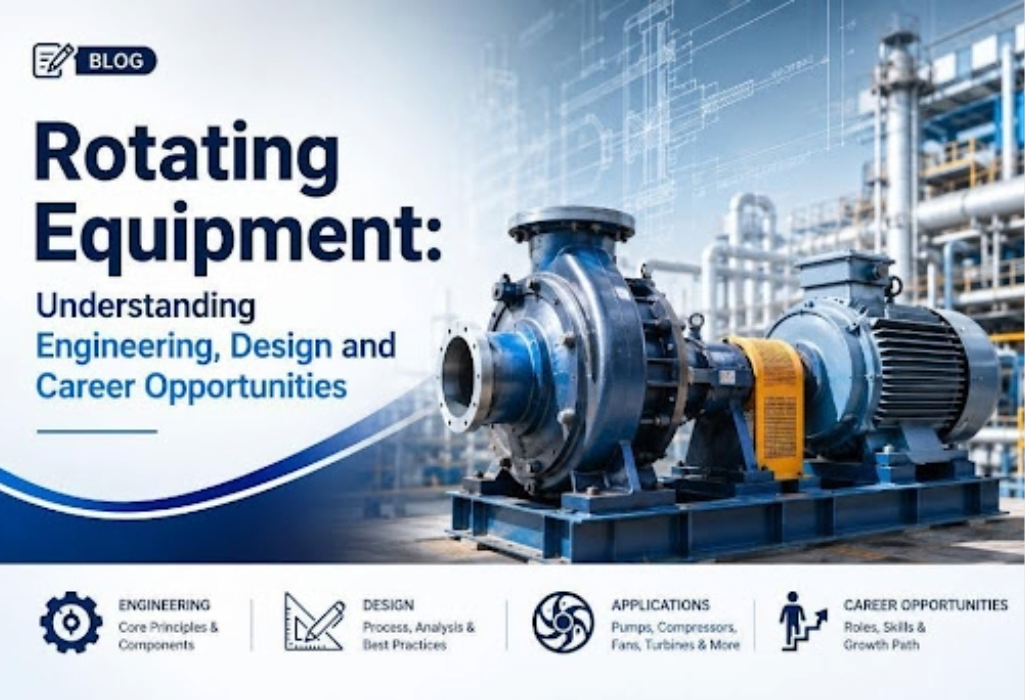
Rotating Equipment: Understanding Engineering, Design and Career Opportunities
Enquiry Now
Rotating equipment is an essential part of many industrial facilities. Pumps, compressors, turbines, and their supporting systems are widely used in industries such as oil and gas, petrochemicals, refineries, power generation, chemicals, and manufacturing. These machines are responsible for moving fluids, transferring energy, maintaining pressure, and supporting critical production processes.
Because rotating machinery operates under demanding conditions, engineers need specialized knowledge to understand equipment selection, performance, design requirements, inspection, testing, and maintenance. Developing expertise in rotating equipment can therefore provide valuable technical skills for mechanical and production engineering professionals interested in process industries and EPC projects.
What Is Rotating Equipment?
Rotating equipment refers to machinery that contains components that rotate during operation. Unlike static equipment such as pressure vessels, storage tanks, and heat exchangers, rotating machines involve moving components such as shafts, impellers, rotors, bearings, and couplings.
Common examples include centrifugal pumps, reciprocating compressors, centrifugal compressors, steam turbines, blowers, and related auxiliary systems.
Each machine has different operating principles and engineering requirements. Understanding these differences is important when selecting equipment for a particular process application.
Importance of Rotating Equipment in Process Industries
Industrial plants depend heavily on rotating machinery. Pumps may transport liquids through process systems, compressors can increase the pressure of gases, and turbines can convert energy into mechanical power.
If critical rotating equipment does not perform correctly, an entire production process can be affected. Equipment failure can lead to downtime, maintenance costs, safety concerns, and production losses.
This makes proper engineering, equipment selection, performance evaluation, inspection, and testing extremely important. Engineers working with these systems need to understand both theoretical principles and practical project requirements.
Centrifugal Pump Engineering
Centrifugal pumps are among the most widely used rotating machines in industrial facilities. They are used for applications involving the movement of liquids and can be configured according to process requirements.
Engineering a centrifugal pump involves understanding parameters such as flow, head, temperature, specific gravity, operating conditions, and system requirements.
Performance curves are important for evaluating pump operation. Engineers also need to understand concepts such as specific speed, suction specific speed, NPSH, NPSH margin, and pump affinity laws.
Different pump configurations, including between-bearing, overhung, and vertical suspended arrangements, may be selected depending on the application.
A strong understanding of pump engineering can help professionals evaluate equipment more effectively and communicate technical requirements during project execution.
Understanding Compressors
Compressors are another major category of rotating equipment. They are used to increase gas pressure and support various processes in industrial facilities.
Reciprocating compressors and centrifugal compressors operate differently and have different engineering considerations.
Reciprocating compressor engineering may involve understanding compressor components, valves, capacity control, unloading methods, power calculations, pulsation, and vibration considerations.
Centrifugal compressor engineering can involve performance characteristics, capacity control, anti-surge systems, dry gas seals, instrumentation, and rotor dynamics.
Understanding these systems is important for engineers involved in equipment selection, specification, vendor evaluation, and project execution.
Steam Turbines and Their Applications
Steam turbines convert the energy of steam into mechanical energy and are used in various industrial and power-generation applications.
Engineers working with steam turbines need to understand turbine classification, major components, auxiliary systems, instrumentation, control requirements, and performance considerations.
Condensing and back-pressure turbines serve different applications and require appropriate engineering evaluation.
Documentation is also an important part of turbine engineering. Equipment datasheets, technical bid evaluations, technical recommendations, specifications, and vendor documents all contribute to successful equipment procurement and project execution.
API Standards in Rotating Equipment Engineering
International standards provide important guidelines for engineering and specifying industrial equipment.
Rotating equipment professionals may encounter standards such as API 610 for centrifugal pumps, API 612 for special-purpose steam turbines, API 614 for lubrication systems, API 617 for axial and centrifugal compressors, API 618 for reciprocating compressors, and API 682 for shaft sealing systems.
Understanding the purpose and application of these standards can help engineers interpret technical requirements and participate more effectively in EPC projects.
Standards knowledge is particularly valuable when preparing specifications, reviewing vendor proposals, evaluating equipment designs, and checking compliance.
Importance of Sealing and Lubrication Systems
Rotating machinery depends on supporting systems to operate reliably.
Shaft sealing systems help manage leakage around rotating shafts, while lubrication systems provide appropriate lubrication to bearings and other components.
Seal systems may involve different flushing and support arrangements depending on the equipment and process conditions.
Lubrication systems are also critical because inadequate or inappropriate lubrication can affect bearing performance and equipment reliability.
Engineers therefore need to understand the functions, selection considerations, and design requirements of these auxiliary systems.
Engineering Deliverables and EPC Projects
Rotating equipment engineering is not limited to understanding machinery. Engineers also need to prepare and review technical documentation throughout the project lifecycle.
Important deliverables can include equipment datasheets, technical specifications, technical bid evaluations, technical recommendations, vendor data reviews, and interface documentation.
In EPC environments, rotating equipment engineers may interact with process, piping, electrical, instrumentation, procurement, and other engineering disciplines.
Understanding the complete project workflow—from concept and basic engineering through detailed engineering, procurement, inspection, testing, and commissioning—can help professionals develop a broader understanding of industrial project execution.
Why Specialized Rotating Equipment Training Matters
Mechanical engineering graduates may understand fundamental engineering principles but can benefit from specialized training focused on industrial rotating machinery.
A dedicated rotating equipment program can connect theoretical concepts with practical engineering workflows. Training may cover equipment fundamentals, performance evaluation, standards, equipment selection, engineering calculations, documentation, vendor review, inspection, and testing.
Suvidya Institute of Technology’s rotating equipment program is designed around these industry-oriented areas and includes exposure to pumps, compressors, steam turbines, sealing systems, lubrication systems, API standards, and EPC engineering deliverables. The institute states that the program is intended for degree or diploma holders in mechanical or production engineering, including freshers and experienced professionals.
Career Opportunities in Rotating Equipment
Professionals with rotating equipment knowledge can explore opportunities across several industries.
Potential roles include rotating equipment engineer, mechanical engineer, maintenance engineer, reliability engineer, equipment engineer, field service professional, and technical engineering roles within EPC organizations.
The oil and gas, petrochemical, refinery, power, chemical, and manufacturing sectors can require professionals who understand critical rotating machinery and associated engineering documentation.
With experience, professionals can take on responsibilities involving equipment selection, technical specifications, vendor coordination, engineering reviews, inspection, commissioning, and project management.
Skills That Can Strengthen a Rotating Equipment Career
Technical knowledge is only one part of becoming an effective rotating equipment professional. Engineers should also develop analytical thinking, problem-solving, communication, documentation, and project coordination skills.
The ability to interpret technical datasheets, understand engineering standards, evaluate vendor information, and communicate effectively with multidisciplinary teams can be valuable in EPC environments.
Continuous learning is equally important because equipment technologies, engineering practices, standards, and digital project workflows continue to evolve.
Conclusion
Rotating equipment is at the heart of many process and industrial facilities. Pumps, compressors, turbines, sealing systems, and lubrication systems must be carefully engineered and coordinated to support safe and reliable plant operation.
For mechanical and production engineering professionals, developing specialized knowledge in rotating equipment can strengthen their understanding of industrial machinery and EPC project execution. Learning about equipment performance, API standards, engineering deliverables, vendor documentation, inspection, and testing can provide a practical foundation for career development.
As industrial projects continue to demand technically skilled professionals, specialized rotating equipment knowledge can be a valuable addition to an engineer’s career profile. Combining engineering fundamentals with practical training and continuous professional development can help aspiring engineers prepare for opportunities across the oil and gas, petrochemical, refinery, power, chemical, and manufacturing sectors.


