
Piping Engineering vs Piping Design: Understanding the Career Difference
Enquiry Now
As an engineering graduate or diploma holder who wants to have a career in the oil and gas, petrochemical, chemical, or process plants industries, then there are two careers that you will frequently come across with: piping engineering and piping design.
Both jobs might sound the same at first; however, they are closely related yet different in many ways.
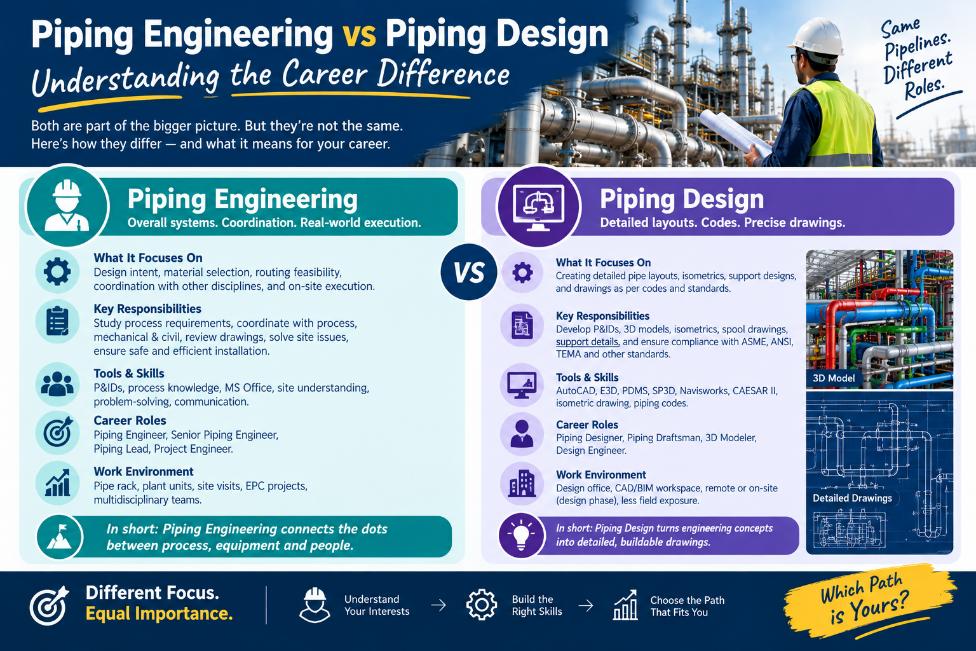
Piping design may involve designing most of the time, whereas piping engineering involves responsibilities that may encompass more than just design and materials of a piping system.
This is very important to know first before joining a training course or deciding what type of career you would like to have in the future. take.
What is Piping Engineering?
Piping engineering is concerned with the engineering aspect of pipes that are used in process plants and industries.
The piping engineer must know how the piping system should be working, how it should be configured, which kind of materials/components should be used, and how the system can be designed based on the engineering requirements and standards.
It may consist of:
- Piping configuration
- Piping material and components
- Equipment/piping interface
- Pipe support
- Piping specification
- Plant layout
- Isometrics
- Stresses & Flexibilities
- Constructability requirements
- Codes & Standards
- Modification and troubleshooting of existing piping systems
Therefore, the scope of the piping engineer does not limit itself to just drawing the piping systems.
Piping engineers can work in various phases of the project – design, lay-out, analysis, construction, operation and maintenance. Piping engineering is especially significant in refineries, petrochemical plants, chemical industries, and process facilities.
What Is Piping Design?
Piping design is much more concerned with translating the engineering specifications into a tangible design.
The piping designer or piping design professional uses drawings, layouts and 3D models to establish how pipes, equipment, valves and other components will be located in the plant.
For instance, a piping designer may work on:
- Engineering drawings of equipment and piping layout
- Routing of piping
- Plot plan
- Pipe rack arrangement
- Piping isometrics
- Bill of materials
- Nozzle orientation
- Pipe support
- 3D plant modeling
- Construction drawings
Software is also an important aspect of today’s piping design process. Depending on the company and the project, the professionals may use AutoCAD, E3D or any other plant design software.
Areas of study at Suvidya’s Piping Design & Drafting include:
- Engineering drawing
- Requirements of process plant drafting
- Piping layout
- Isometric drawing
- Bill of materials
- Pipe rack
- Equipment layout
Piping Engineering versus Piping Design: The Difference between Them
In its very essence, the difference is quite clear:
- Piping engineering is the general concept, while piping design is one of the specific functions within the former concept.
- Piping Engineering
- Piping Design
- Engineering responsibilities overall
- Responsibilities focused on design and drawing mostly
- Technical aspects of piping systems
- Drawing the layouts
- Requirements of materials, layouts, codes and engineering
- Requirements of routing, modeling, drawings and detailing
- Stress and flexibility analysis possible
- More design-related operations required
- Operations related to construction, operation and troubleshooting possible
- Focuses on developing the physical design only
- Should know about the piping system as a whole
- Needs good drawing, modeling and design capabilities
- On the other hand, the concepts are quite close and similar.
Within the real engineering project, all engineers, including piping, designers, stress, process and equipment engineers and others should cooperate. A designer is not able to do his job properly if he does not understand the engineering requirements and vice versa.
Which Is the Better Career Path?
There is no definite answer to this.
It all depends on your preferences and the type of job you wish to take up.
In case you like technical aspects of engineering along with calculations, material, codes, system requirements, and knowledge about the entire piping system, then piping engineering would be a good choice.
In case you are more inclined towards drawing, 3D modeling, layout, equipment arrangement, and dealing more with the designing software, then piping designing would suit you well.
Neither is there any such principle laid down that will bind you to a particular path through your career. The experience gained in designing can help you excel in piping engineering and vice-versa.
What Skills Would You Need?
No matter which career path you opt for, it is never enough just to know the theory.
The following are the three areas a student in this field must focus on.
1. Engineering Fundamentals
One should know about the following:
- Engineering Drawings
- Piping Components
- Valves & Fittings
- Equipment
- Piping Materials
- Plant Layout
- Pipe Supports
- P&IDs
- Isometric Drawings
- Codes & Standards
The above-mentioned fundamentals help to know the reason for a certain arrangement of piping systems and not just how to do the drawings.
2. Design & Engineering Software
Skills in software are required since most of today’s design and engineering workflow consists of computer-based drawings and plant models.
Depending upon the job profile, knowledge of software like AutoCAD, E3D and CAESAR II can be helpful.
For instance, Suvidya’s course on Piping Engineering provides training on E3D and CAESAR II apart from other piping engineering modules.
3. Practical Understanding
It is here that the lack of experience becomes prominent for beginners.
Knowing what a valve is or how to make a CAD drawing does not necessarily mean understanding the use of such components in an actual process plant.
Industrial orientation through assignments, projects, case studies and other practicals can help fill this gap. Suvidya’s training courses describe their curriculum as industry-oriented based on engineering principles and practices along with applicable codes.
Career Opportunities – So What?
Piping is not just one career path.
Based on your qualifications and experience, opportunities are available in fields such as:
- Piping Design
- Piping Engineering
- Piping Layout
- Piping Stress Analysis
- Piping Drafting
- Plant Design
- Construction
- Field Engineering
- Material Engineering
- Estimation
- Technical Support
Opportunities for piping engineers may be available with detailed engineering companies, EPC firms, refineries, petrochemical plants, chemical plants, and other industries.
That is also why knowing the difference between design and engineering is important. Your first job may be more specialized, but your knowledge and experience will decide your future.
Selection of Piping Training Program in Mumbai
For students and professionals seeking piping training in Mumbai, selection of the training program should depend not only on the name of the course.
Focus on the curriculum of the program.
Does the course offer basic engineering concepts? Plant Layouts? Practical Projects? Exposure to industry-specific software? Codes and Standards? Knowledge of interdependence of different branches of engineering in a process-plant project?
These questions will be more relevant than simply asking whether the course is called “Piping Engineering” or “Piping Design.”
Suvidya Institute of Technology provides piping courses in both Piping Engineering and Piping Design & Drafting along with advance courses such as Advanced Pipe Stress Analysis and Process Plant System Modeling using E3D.
It was set up in 2002 and specializes in technical training in engineering disciplines relating to oil and gas, petrochemical and process chemical plants.
The branch of Suvidya Institute of Technology in Mumbai is in Vakola, Santacruz East.
Explore the Piping Engineering course in Mumbai to know the details of the course curriculum and eligibility criteria.
Now, Which One Should You Opt for?
An easy way to do so is by taking into account the kind of job that suits you best.
Opt for the piping engineering stream in case you want wider exposure to:
- Piping
- Engineering specifications
- Materials
- Code
- Plant layout
- Stress and flexibility
- Construction specifications
Think of piping design if your interests lie in:
- CAD
- 2D drafting
- 3D plant design
- Piping routing
- Equipment layout
- Isometrics
- Drafting and detailing
- Neither choice is inherently “better.”
The key is having sufficient technical knowledge so that you do not use the computer blindly and without understanding what you are designing.
The important thing is to build enough technical understanding Concluding Thoughts
Piping Engineering and Piping Design are highly related occupations, and at times, distinguishing one from another may become more difficult with experience.
Rather than asking, “Piping engineering or piping design?”, the correct question to ask is:
“Am I familiar with the workings of a process-plant piping system, and do I want to specialize in that particular aspect of the process-plant?”
This will make choosing the proper training easy.
If you are looking for a piping training course in Mumbai, Suvidya Institute of Technology offers specialized training in Piping Engineering and Piping Design & Drafting.


