
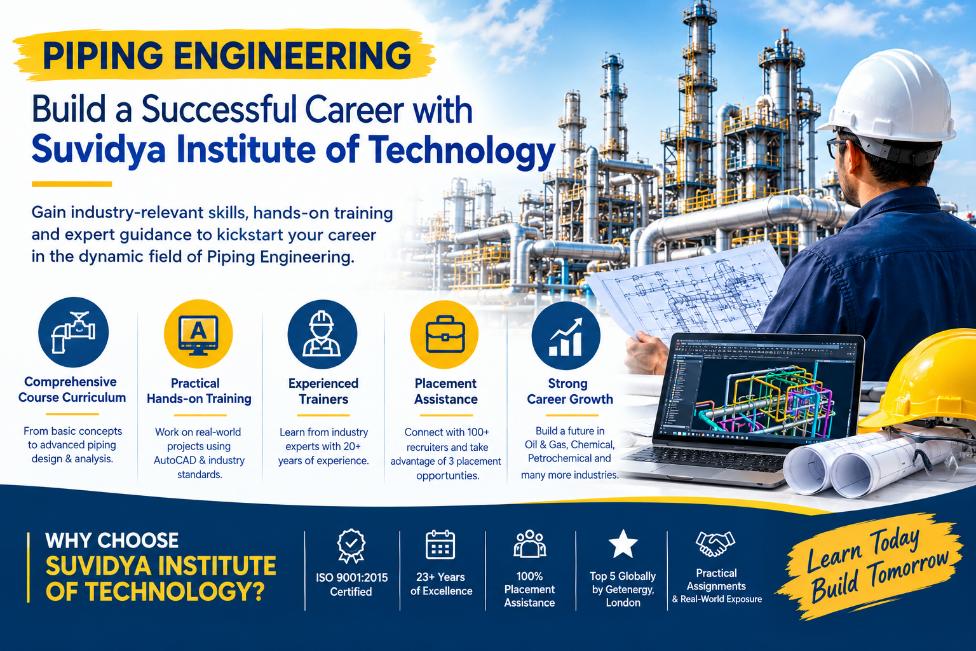
Piping Engineering: Build a Successful Career with Suvidya Institute of Technology
Enquiry Now
Piping engineering is like one of those disciplines that matters a lot in industries where people have to move liquids, gases, steam, and other stuff safely and efficiently. So from oil and gas plants, to refineries, power stations, and chemical processing facilities, piping systems kind of hold everything together. And as infrastructure keeps expanding, and industrial projects keep coming, skilled piping professionals are still needed for designing, installing, and maintaining these complicated setups.
If you’re an engineering graduate, or even someone already working, and you want to specialize, getting practical knowledge plus industry relevant skills can be a real push for new career options. Suvidya Institute of Technology provides technical training so learners can grasp engineering ideas, and get ready for professional roles where the real work happens.
What Is Piping Engineering?
Piping engineering is basically the design, checking / analysis, planning, and development of piping systems that are used inside industrial facilities. These systems carry fluids between major equipment like pumps, compressors, boilers, heat exchangers, storage tanks, and processing units, yes.
A piping engineer has to think about many things while building a system such as operating pressure , temperature , fluid characteristics, material choice, safety rules, and how easy it is to maintain later. Every part needs to work together, otherwise you don’t get that reliable operation, which is the whole point.
It also includes teamwork with other engineering groups, like process, mechanical, civil, instrumentation, and structural engineers. This helps make sure piping layouts match the project needs, and they can actually be installed and kept up without drama.
Because piping systems exist in many industries , professionals with focused knowledge can pick different career paths depending on their qualifications and interests.
Why Piping Engineering Skills Are in Demand
Industrial projects usually require piping systems that are planned carefully so the whole operation stays efficient, and safe. Refineries, petrochemical plants, pharmaceutical facilities, power generation units, and manufacturing plants all rely on piping infrastructure that won’t fail at the wrong time.
Companies working on these types of projects look for people who can understand engineering drawings, piping layouts, technical specifications, and the relevant industry standards. They also prefer candidates who can coordinate with multi-disciplinary teams, and spot possible design or installation problems early on.
Learning specialized piping concepts can help mechanical and chemical engineering graduates broaden their technical understanding. Even professionals already in engineering or construction might benefit from extra training , especially when they want to move toward design , drafting, or project engineering responsibilities.
Sure, the actual job chances depend on your qualifications, experience, and what each employer needs. Still, focused technical education helps candidates build the right skill set for these roles.
Essential Skills Every Piping Engineer Should Develop
A good piping engineer needs a mix of technical understanding, software knowledge, and practical problem solving.
First, reading and interpreting engineering drawings is a key skill. People must be able to understand piping and instrumentation diagrams, piping isometric drawings, equipment layouts, and general arrangement drawings. These documents explain how the piping system should be designed , and how it should be installed.
Second, knowledge of piping components matters just as much. Pipes, valves, fittings, flanges, gaskets, supports, and expansion joints have to be chosen based on project needs and operating conditions, not just randomly.
Material selection plus piping specifications are another big part. Engineers should know how pressure, temperature, corrosion, and fluid behavior decide whether a material is truly suitable.
Also, computer-aided design tools can support your growth. Depending on your role, you may work with AutoCAD , plant design software , or other specialized engineering applications. Learning those tools in a project-like way builds confidence, and helps you move faster.
And beyond the technical side, communication, attention to detail, teamwork, and time management are essential, because piping engineers often coordinate with several departments during a project timeline.
How Piping Engineering Training Supports Career Development
Training can help learners connect theory with real-world usage. Instead of studying in isolation, students can understand how piping systems are designed, documented, and evaluated in actual industrial environments.
A structured program might cover piping layouts, component selection, engineering drawings, design fundamentals, industry standards, and relevant software. Hands-on exercises can make students comfortable with technical documents and with common design considerations, so things feel less unfamiliar.
Training can also show the link between engineering design and project execution. When you understand installation needs, maintenance access, safety concerns, and how departments coordinate, you get a wider view of what industrial engineering actually means.
At Suvidya Institute of Technology, prospective learners can look into training options that align with their background, and their career goals. Before enrolling, students should check the latest course syllabus, the software coverage, practical training parts, and eligibility requirements, so it matches what they expected.
Career Opportunities After Learning Piping Engineering
Piping engineering knowledge can support several technical job roles, depending on the candidate’s qualifications and experience. Suvidya Institute of Technology is an option for learners exploring specialized technical education. Comparing its current program details with personal career objectives can help students make an informed decision.
Start Your Piping Engineering Learning Journey
Piping engineering combines technical knowledge, design skills, and practical problem-solving to support essential industrial operations. Developing expertise in piping layouts, engineering drawings, materials, and design software can help aspiring professionals prepare for opportunities in the engineering sector.
With the right training and consistent practice, learners can strengthen their technical foundation and work toward long-term career development. Explore the piping engineering training options at Suvidya Institute of Technology to understand the curriculum, practical learning opportunities, and skills you can develop for your future in industrial engineering.


