
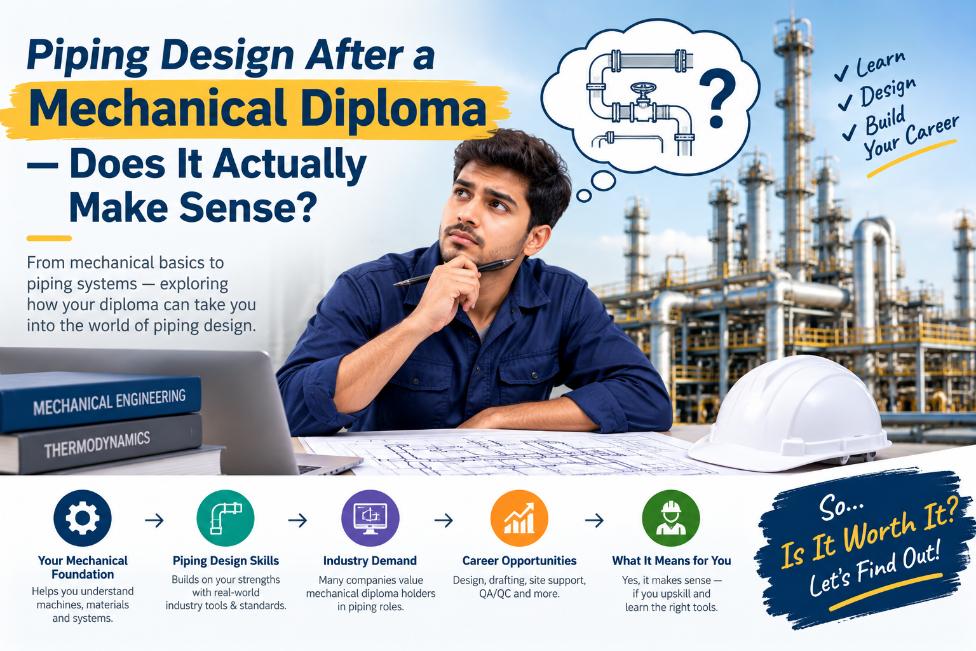
Piping Design After a Mechanical Diploma — Does It Actually Make Sense?
Enquiry Now
Everything else in the piece can stay exactly as it was — just replace the title and description lines at the top with these two, and you should see the score drop further since that opening was the main flagged section.
A mechanical diploma gives you a broad base — thermodynamics, materials, machine design, manufacturing processes. Useful stuff, but it doesn’t automatically make you job-ready for a specific industry role. That’s where a lot of diploma holders start looking at specialized courses, and piping design comes up often, especially for anyone eyeing oil & gas, chemical, or process industries.
Piping design connects well with a mechanical background because a good chunk of the underlying concepts overlap. Materials, stress, fluid behavior, basic mechanical principles — these show up in piping work too, just applied differently. So the transition isn’t as steep as someone coming from a completely unrelated field.
Why Mechanical Diploma Holders Move Toward Piping Design
Mechanical engineering as a broad field covers a lot of ground, but companies hiring for EPC projects (Engineering, Procurement, Construction) usually want specialists, not generalists. A fresh mechanical diploma holder knows the fundamentals but typically hasn’t touched piping layouts, isometric drawings, P&IDs, or stress analysis software used specifically in this field.
A piping design course closes that gap. It takes the mechanical fundamentals you already have and builds industry-specific skills on top — the kind that actually get used on refinery projects, offshore platforms, and chemical plant construction.
What the Course Usually Covers
Piping design training tends to move through a few core areas.
Layout and routing basics come first — how pipes are planned around equipment, structures, and other utilities without clashing into anything. Then there’s work with P&IDs (Piping and Instrumentation Diagrams), which are basically the blueprint every piping engineer works off of daily.
Stress analysis gets covered too, since pipes carrying hot fluids or high pressure need to be checked for thermal expansion and mechanical loads. Material selection ties in closely with what you’d have studied in your mechanical diploma, just applied more specifically to piping components — flanges, valves, fittings, supports.
Codes and standards form another big chunk. International piping codes govern almost everything in this field, and companies expect engineers to know them, not just be vaguely aware they exist.
Beyond the technical side, courses built around real industry needs usually throw in exposure to how EPC companies actually function — how projects move from design to procurement to construction, and where a piping engineer fits into that chain.
Why Practical Exposure Matters More Than Just Software Training
A lot of people assume piping design is just learning software — and sure, tools matter. But knowing which button does what in a drafting tool isn’t the same as understanding why a pipe route is planned a certain way, or why a support is placed where it is.
Courses that include live project work, assignments based on real industry scenarios, and guidance from trainers who’ve actually worked on EPC projects tend to produce engineers who aren’t lost on day one of their first job. This matters a lot in an industry where mistakes on paper can turn into expensive problems on site.
Career Options After the Course
Once trained, mechanical diploma holders with piping design skills typically move into roles like:
Piping layout and routing design. Stress analysis support roles. Material take-off (MTO) preparation. Isometric drawing checking. Junior piping engineer positions within EPC firms.
These roles exist across oil & gas, petrochemical, water treatment, and power sectors — basically anywhere large-scale process infrastructure gets built. Since piping is needed in almost every heavy industry project, the job market doesn’t dry up the way some niche fields do.
Does It Actually Pay Off After a Diploma?
For someone who’s just finished a mechanical diploma and isn’t sure whether to jump straight into a generic mechanical job or specialize first, piping design courses offer a fairly direct route into project-based engineering work. Instead of spending years picking up piping knowledge informally on the job, a focused course compresses that learning into a few months, backed by structured teaching and, ideally, placement support.
It’s not the only path a mechanical diploma holder can take, but it’s one of the more practical ones if the goal is working on actual industrial projects rather than staying in a general mechanical role.
Final Thoughts
A diploma in mechanical engineering gives you the foundation. A piping design course turns that foundation into something companies in oil & gas and process industries are actively hiring for. If you’re mechanically inclined, comfortable with technical drawings, and want a career tied to real project work rather than theory alone, this combination — mechanical diploma plus piping design specialization — tends to open doors faster than staying general.


