
Online Piping Design Course: Curriculum, Software, and Career Scope in 2026
Enquiry Now
The engineering industry is changing kinda fast, and it opens up these new chances for people who have very specific technical skill sets. Among the disciplines seeing major demand, piping engineering has basically become a core part of industrial infrastructure. Like from oil and gas set ups, to pharma manufacturing sites, and even power stations, most big industrial builds, really rely on piping systems that are designed well, so fluids gases, and chemicals move in a safe manner, and with proper efficiency, not just “it runs” kind of thinking.
Now, as companies keep pushing modernization, digital engineering, and sustainable infrastructure, the need for piping professionals is growing across India, and also in international job markets. Employers do not want only an engineering degree anymore. They are asking for practical exposure to piping layouts, design standards, engineering software, plus an understanding of how projects are actually executed on the ground.
Because of that, a lot of aspiring engineers, and even those already working, are trying to upgrade their technical depth through focused training. Taking a piping course has become, one of the clearer paths to build job-ready capabilities and improve employability in these competitive engineering fields.
So in this guide, we’ll jump into the curriculum of an online piping design program, the software tools you’ll learn, career options that look realistic in 2026, and also why professional training can genuinely shift the course of your engineering career.
What Is Piping Design? (kinda simplified)
Piping design is basically the planning, designing, and documentation side of piping systems that are used inside industrial facilities. These systems carry liquids, gases, steam, chemicals, petroleum products, and other process materials, and they do it across a whole plant safely, day after day.
A piping designer typically collaborates with process engineers, mechanical engineers, civil engineers, instrumentation teams, and project managers. Together they create piping routes and layouts that match engineering standards, safety rules, and operational needs.
But unlike some general mechanical design work, piping engineering needs a deeper understanding of pressure ratings, pipe routing logic, how pipes connect to equipment, material selection, stress analysis, fabrication requirements, and construction methods. The smallest design mistake can impact plant performance, raise maintenance costs, and affect overall safety , so it’s not a “rough draft” kind of domain.
Why Piping Engineering Is a High-Demand Career in 2026
Industrial growth isn’t slowing down, worldwide. Huge investments are still flowing into refineries, chemical units, renewable energy plants, pharmaceutical production, LNG terminals, food processing, and water treatment facilities. And all of this is generating a lot of engineering roles every year, especially for people who can handle piping engineering tasks properly.
In India, infrastructure expansion is also adding pressure in a good way, for skilled engineers. Government directions related to manufacturing, smart city initiatives, petrochemical expansion, and energy projects, are demanding experienced piping engineers who can deliver modern industrial systems.
Another reason is digital transformation. Engineering organizations now depend heavily on advanced 3D modeling tools, Building Information Modeling (BIM), and these smarter plant design systems. If you can connect the engineering fundamentals with modern software workflows, you become a stronger candidate during recruitment, not just “someone with a degree.”
Also, many multinational engineering firms hire trained piping professionals for both domestic and overseas projects, because specialized skills lower the training time and can speed up project execution. That is why training matters beyond theory.
Who Should Join an Online Piping Design Program?
The biggest plus point with online technical education is flexibility. You can pick up new skills without fully pausing your studies, or without quitting your job.
Online piping design programs usually fit mechanical engineering graduates, diploma holders, production engineers, plant maintenance professionals, freshers who want industry-relevant knowledge, and experienced engineers who are aiming for a next-step in their career.
For people already working, the online format helps a lot because you can study during evenings or on weekends, while still staying connected to your current role. This means you can upgrade qualifications without losing the experience you’ve already collected.
And many employers actually like candidates who show initiative, like pursuing specialized technical certifications along with their academic background. It looks proactive, and it’s often practical in interviews.
What Does the Curriculum Include?
A good online piping design curriculum blends engineering theory with real application. Instead of only talking in classroom terms, better programs focus on industrial workflows and project-based learning.
At the start, you learn piping engineering basics: pipe materials, fittings, valves, flanges, symbols, and industrial standards. This foundation matters because it helps you understand how the components fit together inside complex process plants, not as separate parts.
Later in the course, you move into piping layouts, equipment arrangements, plant design principles, piping specifications, and line routing methods. The goal is understanding how engineers improve plant efficiency while also ensuring accessibility, safety, and maintainability.
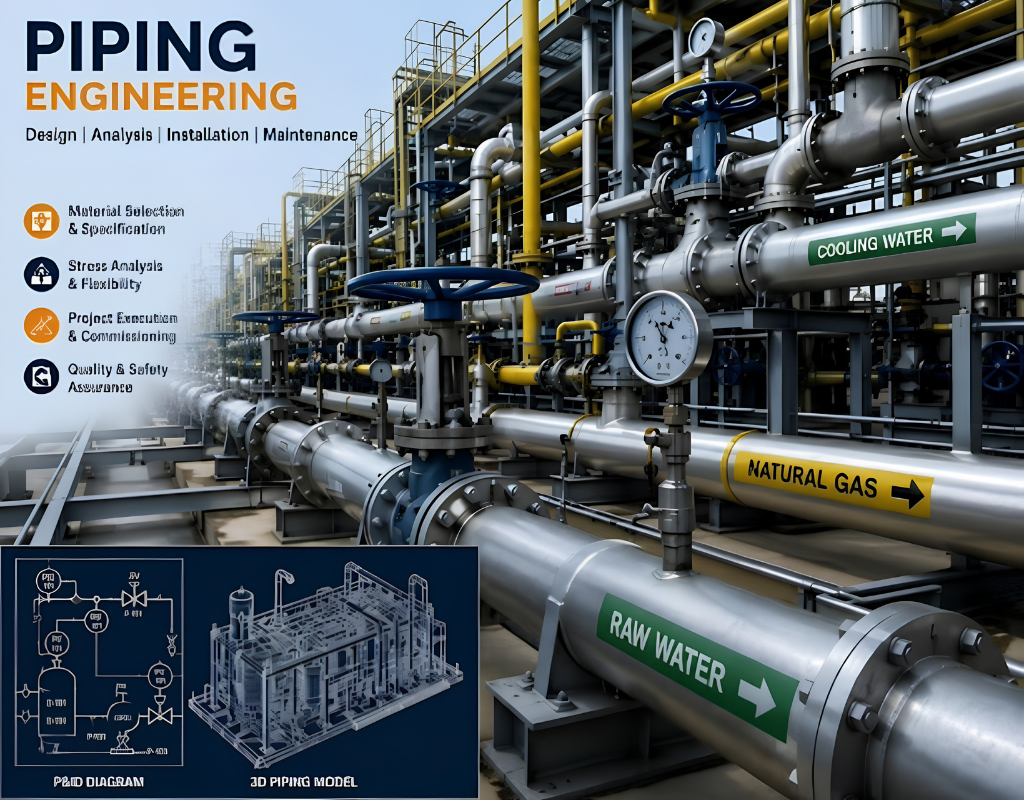
The curriculum usually includes process flow diagrams (PFDs), piping and instrumentation diagrams (P&IDs), isometric drawings, general arrangement drawings, and equipment layouts. Learning to interpret these documents is important because they are basically the backbone of industrial project execution.
Students also study piping supports, pipe stress fundamentals, expansion considerations, insulation requirements, and material selection. These ideas ensure the piping system stays reliable when operating temps, loads, and pressure ranges change.
Hands-On Learning really matters
Just technical know how is not enough anymore in today’s engineering world. Employers usually expect people to grasp how engineering work is actually done, in real time, not just theory.
That’s why solid online training tracks often come with project based tasks that kinda mimic real industrial settings. Learners end up practicing how to read client expectations, create engineering drawings, work alongside multidisciplinary groups, and handle design obstacles that look a lot like what happens on current projects.
Doing these practical assignments boosts self assurance too, and it also helps later for technical interviews, because many employers are checking your reasoning and problem solving skills more than they check memorized stuff.
Plus when students face story like, realistic project situations, they start to see the whole industry flow from design all the way through construction, which makes moving into professional roles way easier.
Software You Will Learn During the Training
During this training you will , well, get a kind of full exposure to the software modern engineering projects use all the time, to improve precision reduce design mistakes and also make it easier for different engineering groups to work together. And because more industries keep moving toward digital engineering, being good with the right software is one of those skills employers usually look for, especially when they are hiring piping professionals.
A solid program usually walks students through tools that are common across industrial work in areas like oil and gas, petrochemicals, pharmaceuticals, power generation, food processing, water treatment, and EPC (Engineering, Procurement, and Construction) , you know.
One of the first things students tend to learn is AutoCAD, it’s still treated as an industry norm for producing 2D engineering drawings, equipment layouts, and construction documentation. When learners understand AutoCAD, they can create clear technical drawings and also explain design intent, in a way that actually makes sense to the project team.
Later on, students get introduced to AutoCAD Plant 3D. This is a strong platform for building intelligent 3D piping models , basically you can see the system in a more complete way. It supports visualization of plant layouts, helps engineers spot clashes before construction, and can also generate engineering documents directly from the digital model, which saves time and confusion.
Many advanced programs may also bring in AVEVA PDMS (Plant Design Management System) plus AVEVA E3D. Both are used pretty widely for large scale industrial projects worldwide. With these, engineers can assemble complex plant models, coordinate between multiple engineering disciplines, and generally speed up the design process.
Another software solution that is common is SmartPlant 3D (SP3D). Built for industrial facilities, it helps engineers design intelligent piping systems, while keeping consistency across multidisciplinary engineering teams, so the whole thing stays aligned.
Students might also get a first look at CAESAR II, a specialized software for pipe stress evaluation. This tool supports the analysis of how piping systems react to pressure, temperature shifts, vibration, and different external forces. Knowing how stress analysis works is important so piping systems stay safe, dependable, and aligned with international engineering expectations.
Depending on the institute, and the curriculum, learners sometimes explore more programs too, related to equipment modeling, engineering documentation, and project coordination. So yes you get hands on familiarity with the types of tools currently used in the industry.
Skills You Develop Beyond Software
Learning software is only part of becoming a strong piping professional. Employers want engineers who grasp the full design workflow, and can actually contribute on multidisciplinary projects.
Throughout the training, students sharpen their ability to read engineering drawings, understand process flow diagrams, and interpret piping and instrumentation diagrams. These documents, are basically the backbone of most industrial projects, so being able to interpret them is not optional—it’s essential.
Learners also build know-how in equipment layout planning, pipe routing, material selection, valve positioning, piping supports, and even fabrication needs. These capabilities help engineers design systems that are realistic in the field, easier to maintain, and consistent with engineering standards.
Another major skill that tends to grow during training is problem solving. Real industrial jobs bring constraints around space, safety rules, equipment accessibility, and overall operational efficiency. Students learn how to compare multiple design options , while keeping technical demands and commercial requirements in balance.
Communication and teamwork matter a lot too. Piping engineers regularly collaborate with civil, mechanical, electrical, instrumentation, and structural teams during the full project cycle. Building those collaborative habits prepares learners for real workplace situations, not just classroom exercises.
For people aiming to become engineers, signing up for a professional piping course also gives a chance to combine theory with practical industry skills, which can make candidates more competitive in today’s engineering job market.
Career Opportunities Continue to Expand in 2026
The requirement for skilled piping professionals is likely to stay strong through 2026, because industrial investment continues to rise across multiple sectors. Governments and private companies keep putting money into infrastructure, manufacturing plants, renewable energy projects, and industrial upgrades, and that creates ongoing work for qualified engineers.
Engineering consulting firms, EPC companies, manufacturing organizations, refinery operators, pharmaceutical companies, and power generation businesses all depend on piping specialists. They need them for plant design, and for plant expansion tasks.
The push toward digital engineering has also increased interest in professionals who can develop intelligent 3D plant models, while coordinating with multidisciplinary design teams. People with hands on software practice plus project based training often get a recruitment edge, since they usually need less onboarding before they can support live work.
Also, beyond local roles, many qualified piping professionals find opportunities with multinational engineering companies working on projects across the Middle East, Southeast Asia, Europe, and other global markets. As infrastructure keeps expanding around the world, experienced piping engineers keep being in high demand for their technical insight.


