
MEP Course: Build Your Career in Mechanical, Electrical, and Plumbing Engineering
Enquiry Now
Real buildings aren’t just about good look, strong base, and “pretty plans”, they also lean heavily on smart electrical systems, dependable plumbing runs, ventilation, air conditioning, fire safety and a bunch of other building services things. These services should cooperate , not fight each other, so people stay comfortable, safe, and the whole place doesn’t waste energy. That’s kind of the big reason MEP engineering matters.
If you’re an engineering graduate or you know you want to enter construction and building services, a MEP course can be a useful first move , to build real technical know how, not only theory. Suvidya Institute of Technology also provides training and technical education pathways for learners who want to explore focused engineering fields, and also build career direction.
What Is MEP Engineering?
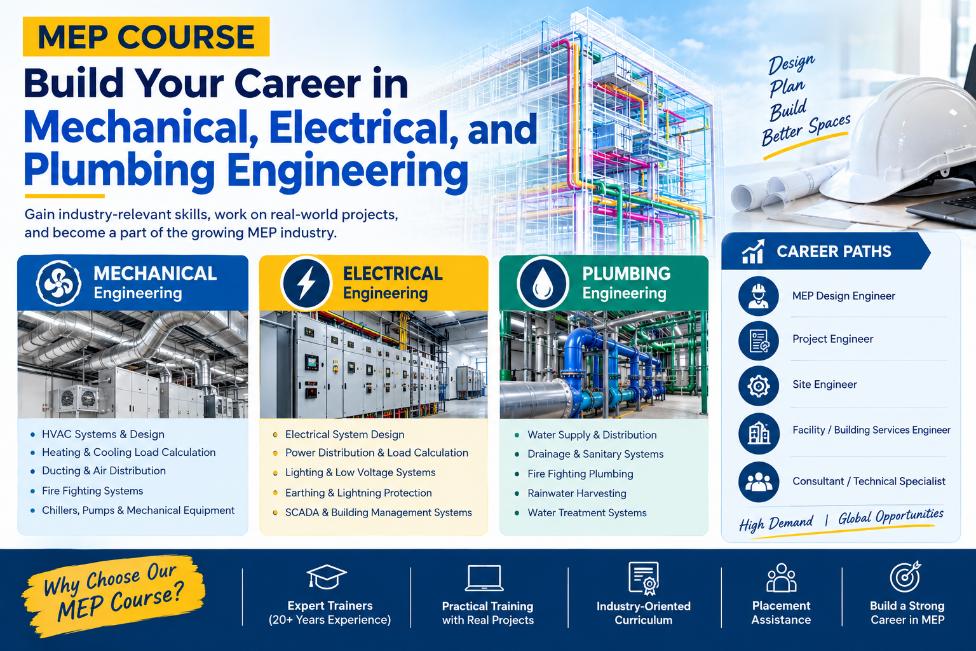
MEP means Mechanical, Electrical, and Plumbing. It’s basically a specialty in building engineering that deals with designing, coordinating, installing, and maintaining the essential services inside residential, commercial, and industrial buildings.
In the mechanical side, MEP usually covers heating, ventilation, and air conditioning, often you’ll hear HVAC. These systems manage indoor temperature, air movement, and overall comfort levels , so the building stays livable.
Electrical engineering within MEP includes lighting, power distribution, electrical panels, wiring layouts , and the related systems needed so everything works safely, and efficiently too.
Plumbing engineering takes care of water supply lines, drainage, sanitary arrangements, and those piping networks that support daily building operations, in short the everyday “water side” of the building.
MEP people coordinate all these systems so they fit the building design , meet the required rules, and keep running properly across the whole life of the project.
Why Choose an MEP Course?
Right now, the construction industry leans more on professionals who understand modern building services and who can coordinate different engineering systems smoothly. As places like residential complexes, hospitals, shopping centres , offices, hotels, and industrial facilities become more advanced, the need for specialized technical knowledge just keeps growing.
An MEP course can help learners understand building services basics and how mechanical, electrical, and plumbing systems are built into construction projects.
For mechanical, electrical, and civil engineering graduates, the training may open specialized roles inside the construction sector. Even working professionals sometimes go for MEP training if they want to deepen their technical knowledge, or shift toward building services design and coordination.
A properly structured program can bridge that annoying gap between college learning, and what projects really demand on-site.
Important Skills Covered in MEP Training
A solid MEP training program typically introduces the key building systems used in today’s projects. The actual content can vary based on the institute and course level, but the themes stay pretty similar.
Mechanical and HVAC Systems
Mechanical services are a big piece of MEP engineering. Students may study HVAC fundamentals, ventilation requirements, cooling and heating systems, duct layouts, and equipment selection.
When learners understand this, they can better connect indoor air quality, thermal comfort, and energy efficiency with actual building design choices, so it doesn’t become random guess work.
Electrical Building Services
Electrical MEP training often covers electrical layouts, lighting design principles, power distribution, cable routing, electrical panels, and load calculations.
This helps learners see how electrical services are planned and coordinated within a building. Plus, practical drawing knowledge and design documentation can really support entry-level technical roles.
Plumbing and Drainage Systems
Plumbing services move water and wastewater through the building in an orderly way. Training can include water supply layouts, drainage networks, sanitary fixtures, piping arrangements , and system coordination.
Learners also practice interpreting how plumbing systems appear in technical drawings , and how they get integrated into building plans.
MEP Design Software
Digital design tools are now a normal part of construction work. Depending on the program, students may get familiar with AutoCAD, Revit MEP, or other building design applications.
These tools support creating technical drawings, 3D models, and coordinated building services layouts. When someone understands the software, it can help them work faster with engineering teams and project documents, so delays don’t happen as often.
Career Opportunities After an MEP Course
Finishing an MEP course may prepare you for entry-level openings in building services and construction, but it depends on your background and practical effort too.
Possible job titles include MEP design engineer, HVAC design engineer, electrical design engineer, plumbing design engineer, MEP draftsman, BIM modeller , and MEP coordination assistant.
What these roles do can change. Designers usually prepare layouts and technical documentation, while coordination professionals help notice clashes between different building systems before installation.
With more experience, extra training, and real project exposure, professionals can move toward senior design, BIM coordination, project engineering, or building services management.
Job outcomes depend on qualifications, software skill, market demand, and what employers expect. Completing a course alone doesn’t automatically lock in a specific job or salary.
How to Choose the Right MEP Training Institute
Choosing the right institute is kind of a big part of your professional development, honestly. Before you enroll, take a moment to look at the course syllabus, check the practical training options , consider the instructor experience too, and then review the software coverage and assessment methods as well.
A good program should explain how building services really operate, and at the same time show how engineering ideas get applied in actual projects. It helps if there are hands-on exercises with drawings, layouts, and design coordination, because those small practice sessions can build confidence quicker than only theory. Also, don’t forget to see how the class schedules work in real life.
Students should confirm course duration, eligibility criteria, batch timings, fees , and whether the institute provides any employment assistance, if that matters to you. Sometimes those details are buried, so it’s better to ask.
Suvidya Institute of Technology can be an option if learners are looking into specialized engineering education. Before committing, prospective students should check the latest MEP course details and compare the curriculum with their career goals; otherwise, you might regret it later.
Begin Your Journey with Suvidya Institute of Technology
MEP engineering mixes mechanical, electrical, and plumbing systems so buildings can stay safe, comfortable, and efficient. Learning about HVAC, electrical layouts, plumbing networks, technical drawings, and design software can help new professionals prepare for roles in the construction and infrastructure sectors.
If you want to build a career in building services engineering, explore the MEP course at Suvidya Institute of Technology, and focus on the training options, the curriculum, and the practical skills you can actually develop. With steady learning and practical, hands-on experience, you can form a stronger technical base , and move toward your long-term engineering career objectives.


