
Job Opportunities for Instrumentation Diploma Holders in India and Abroad
Enquiry Now
Instrumentation engineering has this big role in industries where precise measurement, process watching, automation, and control systems are kind of the main thing. From oil and gas refineries to pharma plants and even power generation units, instrumentation professionals are basically helping industrial processes run smoothly, safely , and reliably.
For students who finished a diploma in instrumentation engineering, the career path can open up into technical operations, upkeep, calibration, automation, and also engineering design tasks. With focused training and hands-on practical competence, candidates may look for jobs in India, and also in global or outside markets.
But it really helps to know the job roles that are actually available, which skills are expected, and what the industry is looking for. That way diploma holders can plan their next career move without guessing so much.
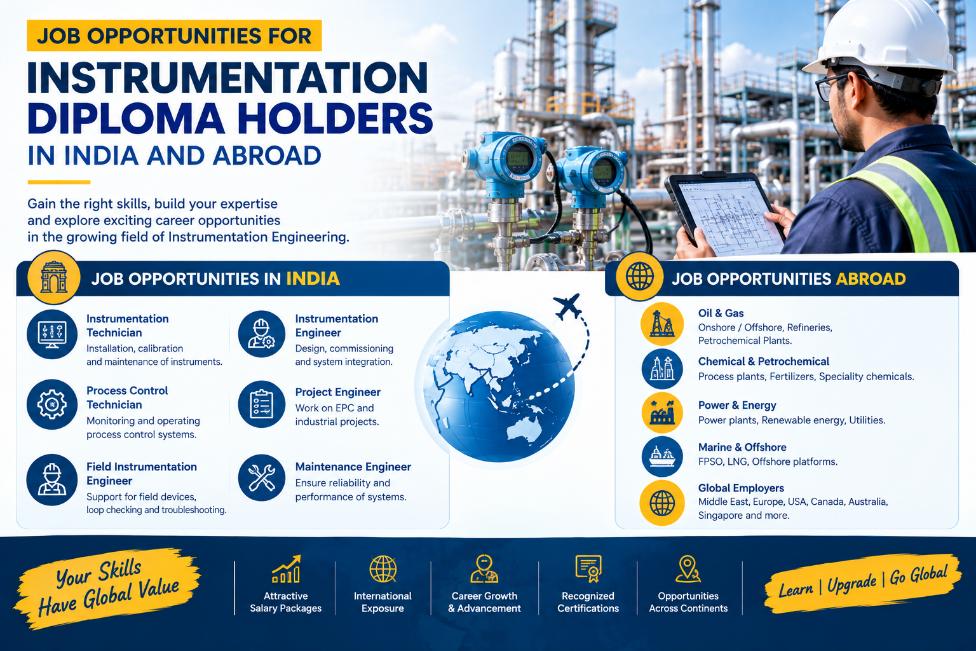
Career Opportunities for Instrumentation Diploma Holders in India
In India, there are many sectors that use instrumentation plus process control systems. So candidates can try options in manufacturing units, engineering consultancies, automation companies, and industrial project organizations.
Instrumentation Technician
Instrumentation technicians set up, examine, test ,and maintain the instruments that are used to measure pressure, temperature, flow, and liquid levels. They make sure the instruments stay correct, and they support daily maintenance duties in industrial locations.
Calibration Technician
Calibration technicians verify measuring tools against defined benchmarks, and they help keep measurement reliability intact. Their work matters in pharma production, chemical operations , food processing, and quality control surroundings.
Control System Technician
These professionals support monitoring and keeping industrial control systems in good shape. They may work with PLC, DCS, and SCADA technologies, which are often used for control and data handling in plants.
Instrumentation Design and Drafting Assistant
If a candidate has the right technical groundwork, they can assist engineering teams for instrument layouts, loop diagrams, hook-up drawings, instrument indexes , and other technical documents. Even basic computer-aided design exposure can be helpful here.
Maintenance and Automation Technician
In manufacturing plants and process industries, technicians inspect equipment, detect faults, support preventive maintenance, and assist when automation systems have troubleshooting needs.
Exact duties and eligibility can differ depending on employer, experience, and the type of project underway.
Job Opportunities for Instrumentation Diploma Holders Abroad
Outside India, there are also opportunities for qualified instrumentation professionals, especially in industrial segments that depend on process automation and control engineering.
Countries like the United Arab Emirates, Saudi Arabia, Qatar, and Oman have major oil and gas , petrochemical, power, and infrastructure sectors. Those fields may hire instrumentation technicians, calibration technicians, control system technicians, plus other supporting technical staff.
Candidates can also look into manufacturing, water treatment, pharma, and industrial automation roles in other countries.
Still, working abroad usually depends on multiple aspects, such as real practical experience, employer conditions, work permits, local rules, and the candidate’s technical credentials. Fresh diploma holders may need to gain relevant experience first, before qualifying for many overseas roles.
Why Consider a Diploma in Instrumentation Engineering Specialised Course?
A specialised programme can help diploma holders reduce the gap between classroom knowledge and what industries use in real life. It connects learners with technical concepts, documentation standards, and the tools used in actual engineering environments.
Suvidya Institute of Technology Pvt. Ltd. offers a Post Graduate Diploma in Process Instrumentation and Control for eligible diploma and degree holders in instrumentation and related areas. The programme generally covers instrumentation basics, measurement devices, PLC, DCS, SCADA, control valve sizing, engineering drawings, procurement, and inspection.
The institute mentions both full-time and weekend training formats, based on the current batch schedule. Practical, industry-focused learning can help candidates prepare for relevant technical roles, however, employment outcomes still depend on individual performance and employer requirements.
To confirm eligibility criteria, syllabus topics, and the current admission details, check the Instrumentation and Control course page.
You can also browse other engineering training programmes provided by Suvidya Institute of Technology Pvt. Ltd. to find a learning pathway that fits your goals.
How to Improve Your Employment Prospects
Instrumentation diploma holders can strengthen their career prospects by developing practical skills alongside their formal qualifications. Learning to interpret P&IDs, understand control system architecture, and prepare technical documentation can improve readiness for engineering-related roles.
Candidates should also prepare a clear technical resume, practise interview questions, and understand the safety procedures relevant to their target industry. Those planning to work abroad should research country-specific qualification requirements, recruitment processes, and visa regulations before applying.
Conclusion
A diploma in instrumentation engineering can open pathways into industrial automation, calibration, maintenance, process control, and engineering design support. Opportunities are available across India, while international positions may become accessible as candidates gain relevant skills and experience.
The right combination of technical knowledge, specialised training, and practical exposure can help you work towards your career goals. Explore the instrumentation and control training offered by Suvidya Institute of Technology Pvt. Ltd. to understand how additional industry-focused learning can support your professional development.


