
How To Become an AC Technician in 6 Easy Steps (Plus Skills)
Enquiry Now
Air conditioning has become an important part of homes, offices, shops, hospitals, hotels, factories, and other commercial spaces. As temperatures rise and more people depend on cooling systems, the demand for trained air conditioning professionals continues to grow. This makes becoming an AC technician a practical career option for people interested in hands-on technical work.
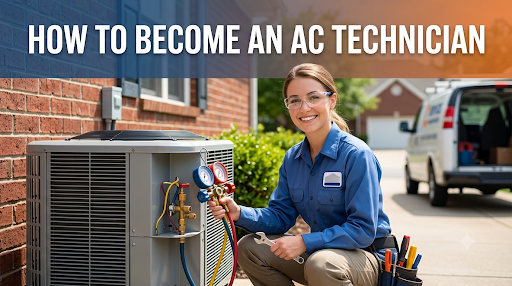
An AC technician installs, services, maintains, troubleshoots, and repairs different types of air conditioning systems. The role requires technical knowledge, practical experience, problem-solving ability, and a strong understanding of safety procedures.
If you are wondering how to become an AC technician, the process can be easier when you follow a structured path. Here are six important steps to help you get started.
1. Complete Your Basic Education
The first step toward becoming an AC technician is completing your basic education. A strong foundation in mathematics, science, and basic technical concepts can be useful when learning refrigeration and air conditioning systems.
Students who are interested in this career can consider vocational education or technical training after completing their school education. Depending on their career goals, they may pursue an ITI trade, diploma, certificate program, or specialized HVAC training.
Basic education helps students develop the ability to understand measurements, electrical concepts, diagrams, tools, and technical instructions.
2. Enrol in an HVAC or AC Technician Course
The next step is to gain specialized technical training. An AC technician course can introduce students to the fundamental principles behind air conditioning and refrigeration systems.
Training may cover topics such as refrigeration cycles, compressors, condensers, evaporators, expansion devices, electrical components, refrigerants, thermostats, and air distribution systems.
Students can also learn about different types of systems, including split ACs, window ACs, inverter ACs, cassette ACs, ductable systems, and commercial cooling equipment.
Choosing a practical training program is important because AC servicing requires hands-on skills in addition to theoretical knowledge.
3. Develop Practical Installation and Repair Skills
Classroom knowledge alone is not enough to become a successful AC technician. Practical experience is essential for understanding how cooling systems operate in real-world situations.
During training, students should learn how to install air conditioning units, connect electrical components, inspect refrigerant lines, clean filters and coils, identify faults, and perform routine maintenance.
They should also become familiar with tools such as multimeters, pressure gauges, vacuum pumps, manifold gauge sets, leak detectors, and other equipment used for servicing AC systems.
Working under the supervision of an experienced technician can help beginners understand how to diagnose problems and perform repairs correctly.
4. Learn Electrical and Refrigeration Fundamentals
Air conditioning combines several technical disciplines, so understanding electrical and refrigeration fundamentals is extremely valuable.
Technicians need to understand concepts such as voltage, current, resistance, circuits, motors, capacitors, relays, wiring, and electrical safety. These skills help them identify electrical faults and troubleshoot equipment more effectively.
Refrigeration knowledge is equally important. Technicians should understand how refrigerant moves through the system and how pressure and temperature affect the cooling process.
A good understanding of these fundamentals allows technicians to identify the underlying cause of a problem rather than simply replacing components.
5. Gain Industry Experience
Once basic training is complete, gaining practical industry experience should be the next priority. Beginners can work as trainees, apprentices, assistants, or junior technicians under experienced professionals.
Field experience exposes technicians to different types of AC systems and customer requirements. They may work on residential installations one day and commercial equipment the next.
Experience also helps technicians improve their troubleshooting abilities. Problems encountered in the field may not always match textbook examples, so learning how to systematically inspect equipment and identify faults is an important part of professional development.
Over time, technicians can become more confident handling installations, servicing, maintenance, and repairs independently.
6. Continue Learning and Build a Career
Technology in the HVAC industry continues to evolve. Modern air conditioners increasingly include inverter technology, smart controls, energy-efficient components, advanced sensors, and connected monitoring systems.
Technicians should therefore continue updating their knowledge after completing their initial training.
Additional certifications and specialized courses can help professionals develop expertise in areas such as commercial HVAC systems, refrigeration, inverter technology, electrical troubleshooting, or industrial cooling.
Experienced technicians can eventually explore different career paths. They may work for HVAC companies, appliance service organizations, construction companies, facility management firms, hotels, hospitals, manufacturing facilities, or start their own AC service business.
Essential Skills for an AC Technician
Technical training is only one part of becoming a successful technician. Several practical and professional skills can improve career prospects.
Technical Knowledge
Technicians need a strong understanding of air conditioning, refrigeration, electrical systems, components, tools, and maintenance procedures. Continuous technical learning is particularly important as equipment becomes more sophisticated.
Troubleshooting Ability
AC diploma courses problems can have multiple causes. A technician needs to inspect the system systematically, identify symptoms, test components, and determine the actual source of the problem.
Strong troubleshooting skills can save time and help prevent unnecessary replacement of working components.
Electrical Skills
Many AC problems are related to electrical components. Understanding wiring, motors, capacitors, relays, circuits, and electrical testing can help technicians diagnose faults safely and accurately.
Physical Fitness and Manual Dexterity
AC technicians often work in different environments, including rooftops, outdoor areas, tight spaces, and elevated locations. The job may require lifting equipment, using hand tools, climbing ladders, and working in different weather conditions.
Good physical coordination and safe working practices are therefore important.
Communication Skills
Technicians frequently interact directly with customers. They need to explain problems clearly, discuss required maintenance or repairs, and provide instructions for proper equipment use.
Professional communication can help technicians build trust and develop long-term customer relationships.
Safety Awareness
Air conditioning work can involve electricity, pressurized systems, refrigerants, rotating equipment, and elevated installations. Following appropriate safety procedures is essential.
Technicians should use suitable protective equipment, follow equipment instructions, handle refrigerants responsibly, and avoid taking unnecessary risks during installation or repair work.
Career Opportunities for AC Technicians
After gaining training and experience, AC technicians can explore several career options.
Residential AC servicing is one common pathway, where technicians install and maintain systems in homes and apartments.
Commercial HVAC is another option. Technicians may work with cooling systems used in offices, shopping centres, restaurants, hotels, hospitals, and other commercial buildings.
Experienced professionals can also move into refrigeration, industrial cooling, HVAC maintenance, technical supervision, or facility management. Some technicians eventually establish their own service businesses and build a customer base through installation and maintenance services.
Final Thoughts
Becoming an ac diploma courses technician can be a rewarding career for individuals who enjoy practical work, technology, troubleshooting, and hands-on problem-solving. The journey starts with basic education and technical training, followed by practical experience and continuous skill development.
The six key steps are simple: complete your basic education, pursue specialized AC or HVAC training, develop practical skills, understand electrical and refrigeration fundamentals, gain industry experience, and continue learning as technology evolves.
With the right training, safety awareness, practical experience, and professional attitude, aspiring technicians can build a strong career in the growing air conditioning and HVAC industry.


