
How Long Does It Take to Become an HVAC Technician?
Enquiry Now
Heating, Ventilation, and Air Conditioning (HVAC) systems are basically a must in residential buildings, offices, hospitals, hotels, shopping centres, and industrial facilities. In today’s buildings, people are always pushing for smoother cooling, smarter ventilation, and better indoor air quality, so trained HVAC professionals matter a lot—especially for installation, maintenance, and overall system design.
If you’re thinking of stepping into this field, you might wonder: how long does it take to become an HVAC technician? Honestly, it depends on where you’re starting from, what training you pick, and how much real hands-on experience you actually get.
Whether you’re a complete fresher or someone already working and trying to upgrade, knowing the HVAC course duration can help you map your next steps.
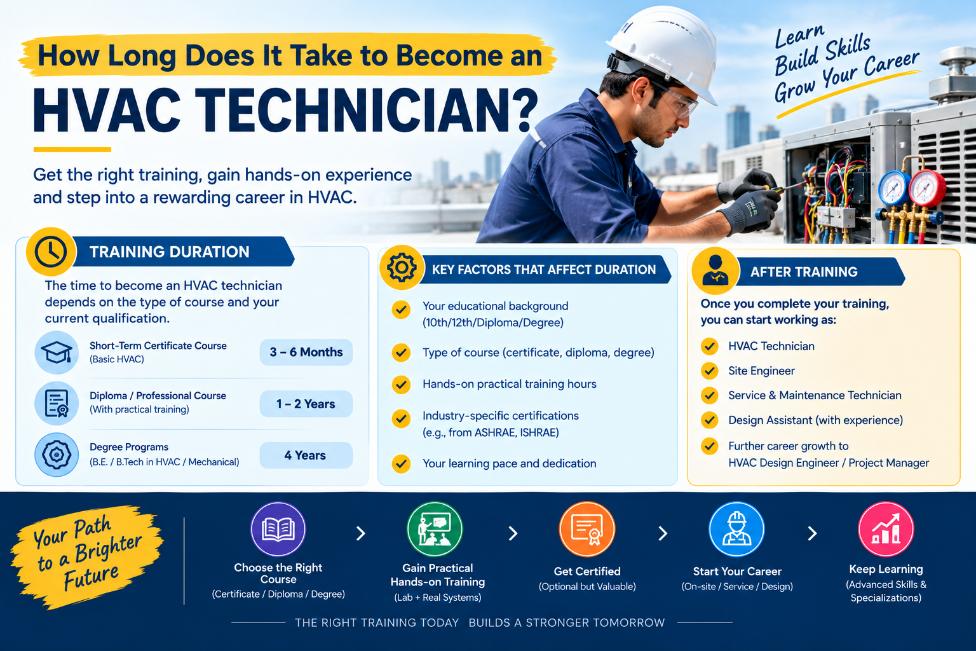
How Long Does It Take to Become an HVAC Technician?
The time to learn HVAC skills changes with the training programme and the career track you want to follow. Short-term courses can give you the core ideas in a few weeks or months, but becoming comfortable with practical work, troubleshooting, and workplace exposure takes longer, period.
Also, finishing a short course doesn’t instantly turn you into an experienced technician. Job readiness depends on the skills you build, your qualifications, and what the employer expects from the role.
What Is the HVAC Course Duration at Suvidya Institute of Technology?
The course duration depends on the programme and batch format you choose. Suvidya Institute of Technology Pvt. Ltd. offers an Air Conditioning System Design (HVAC) programme with different schedules.
What Do You Learn During HVAC Training?
A proper HVAC training programme should help you understand how air conditioning and ventilation systems run in real life. The topics you cover depends on whether the course leans more toward servicing equipment or toward engineering design.
HVAC Fundamentals
You’ll learn the basic concepts behind heating, ventilation, air conditioning, refrigeration, and heat transfer. When you understand these, you can more easily recognise how cooling systems function and why each part is important.
Air Conditioning Systems and Components
Training may cover various types of systems, like split AC units, window AC units, packaged systems, and central air conditioning. You may also study the role of compressors, condensers, evaporators , and fans.
Troubleshooting and Maintenance
If the programme is technician-focused, the training usually includes practical work for fault identification, preventive maintenance, electrical checks, plus safe equipment handling. These abilities help professionals spot common issues and keep systems running reliably.
HVAC Design and Calculations
If the programme is more design-oriented, you’ll cover heat load calculations, duct sizing, ventilation planning, air distribution, equipment selection, and technical drawings. This is especially helpful if you want to move toward HVAC design or engineering type roles.
What Qualifications Do You Need to Become an HVAC Technician?
Entry requirements vary by training provider and by the job role you want. Some technician-type programmes accept candidates with ITI or another relevant vocational qualification. Other specialised engineering design courses may ask for a diploma or degree in a related field.
For instance, Suvidya Institute of Technology mentions fresh and experienced diploma or degree holders in mechanical and production engineering as eligible for its Air Conditioning System Design (HVAC) programme.
Before you enroll, review the eligibility requirements carefully. If your aim is equipment installation and servicing, don’t assume every HVAC design course gives the same practical preparation. Choose training that includes suitable technician skills.
Career Opportunities After HVAC Training
Once you finish a suitable course and build the required practical capabilities, you can explore roles in different directions. For example
- HVAC Technician: installs, inspects, services, and maintains air conditioning equipment
- AC Service Technician: finds issues in common equipment, then performs maintenance and repair work
- HVAC Maintenance Technician: supports the upkeep of heating, cooling , and ventilation systems in buildings and facilities
- HVAC Design Assistant: supports engineering teams with calculations, equipment selection, and technical drawings (when qualified for that role)
- HVAC Design Engineer: works on system planning, cooling load calculations, ventilation planning, and equipment specifications, usually needing relevant engineering qualifications
How to Choose the Right HVAC Training Near You
When searching online for HVAC technician training near me, do not choose a programme based on location or duration alone. Check whether the syllabus matches your career goals and whether the training provider offers the right combination of theory and practical learning.
Review the instructor’s experience, course topics, equipment exposure, software training where relevant, and available career guidance. Ask whether the programme focuses on HVAC servicing, installation, design, or drafting.
You should also confirm the current batch schedule, fees, eligibility, and certificate details before making a decision.
If you are interested in engineering design, explore the HVAC programme offered by Suvidya Institute of Technology Pvt. Ltd.. Its specialised engineering courses can help eligible learners build knowledge of technical systems and industry practices.
Conclusion
Becoming an HVAC technician can take a few months of structured training, followed by practical experience to develop confidence and workplace competence. The exact timeline depends on the course, your previous qualifications, and the skills required for your chosen role.
Before deciding, compare the HVAC course duration, syllabus, practical learning opportunities, and admission criteria. If your interests lie in air conditioning system design, explore the programme offered by Suvidya Institute of Technology Pvt. Ltd. to understand its training options and determine whether they align with your career goals.
Choosing the right course is an important first step towards building a career in the HVAC and building services industry.


