
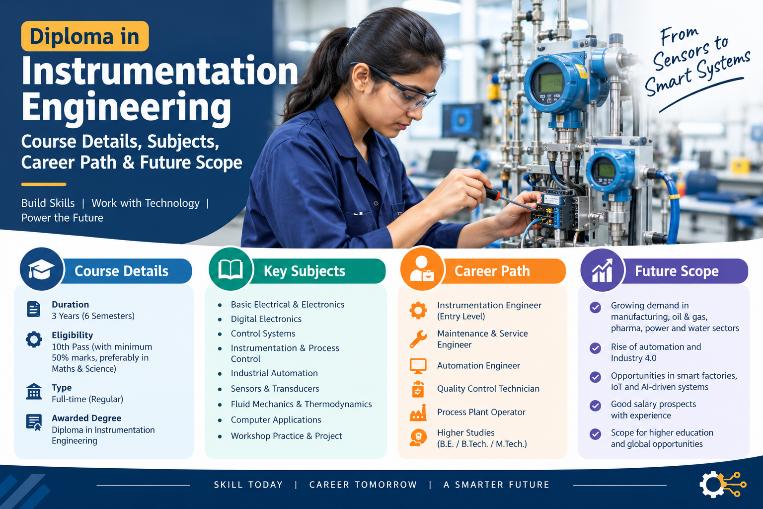
Diploma in Instrumentation Engineering: Course Details, Subjects, Career Path & Future Scope
Enquiry Now
Walk into any refinery or chemical plant and you won’t see much manual labor happening. Most of it is control panels, sensors, wiring, and systems working in the background. That’s instrumentation at play, and honestly, it’s a field a lot of people overlook until they actually start looking into industrial careers.
The Diploma in Process Instrumentation & Control is built around this exact gap. It’s meant to take someone with a basic engineering background and get them ready to actually work in plants — refineries, oil & gas units, chemical facilities, food processing, bottling plants, that sort of thing. Not just theory for the sake of a certificate.
Why This Field Is Getting More Attention
Automation has been creeping into every corner of process industries for a while now, but it’s picked up pace recently. Plants need constant monitoring — temperature, pressure, flow, level — and when something’s off, there’s no time for a person to manually catch it and react. The control system has to do that instantly.
This is basically what instrumentation and control does. It connects mechanical equipment with electronic systems so plants can run with less manual intervention, fewer errors, and better safety. Because of that, companies aren’t just hiring people who know the theory. They want people who’ve actually handled real instruments, real drawings, real plant scenarios.
Who This Course Is For
This diploma works for two kinds of people, really:
Fresh diploma or degree holders in Instrumentation or Electronics who want to specialize further before entering the job market. And working professionals already in the field who want to upgrade their skills or move into design-heavy or technical roles.
Either way, the course is structured so both groups get something out of it.
What’s Actually Covered in the Course
A lot of instrumentation programs stay stuck in theory for too long. This one moves fairly quickly into applied knowledge — the kind you’d need standing in front of an actual control panel.
Basics first. Before anything technical, the course covers what an instrumentation engineer actually does day to day, gives an overview of the industry, and builds up fundamental concepts. Skipping this part usually causes trouble later, so it’s covered properly.
Instruments and their selection. You go through different instruments used for pressure, temperature, flow, and level, plus control valves. More importantly, you learn when to use which one — that’s usually the harder part.
DCS, PLC and SCADA. This is probably the meatiest section. You study Distributed Control Systems, Programmable Logic Controllers, and SCADA setups, since these run most modern plants. There’s also actual PLC programming work using ladder diagrams, specifically for emergency shutdown logic, along with SCADA programming practice.
Fire and gas systems. Given how dangerous oil & gas and chemical environments can get, this section covers fire and gas detection systems, flow calculations, and control valve sizing. Standards and codes for instrumentation are covered here too, because in this line of work, cutting corners on protocol isn’t really an option.
Procurement and inspection. Not the most exciting topic, but a necessary one — how instruments get procured, checked, and approved before they’re installed.
Design engineering. This part gets into P&ID diagrams, data sheets and spec sheets, and loop/hook-up drawings. These are the documents instrumentation engineers work with constantly on the job.
Diagrams and testing. More work with P&ID diagrams, emergency shutdown system layouts, and an introduction to FAT and SAT procedures — basically how equipment gets tested before and after installation. Documentation and technical bid evaluation are part of this too.
Site visit. There’s usually a visit arranged to an actual industrial plant, running or shut down. This tends to be the part students remember most, since it’s very different seeing a control valve on paper versus seeing it installed on a real line.
Batch Timings
There are generally two options here:
A full-time batch, which runs about a month, six days a week, usually in the morning hours. And a weekend batch, spread across roughly three months, meeting once a week for a longer session.
So depending on whether someone’s a fresh graduate with time on their hands or a working professional trying to squeeze this in around a job, there’s a format that fits.
Where This Can Take You
This is the part most people care about most.
Instrumentation engineers are needed pretty much everywhere process industries exist — refineries, chemical plants, oil & gas, food processing, bottling units, and large manufacturing setups. As more of these industries lean into automation, the demand for people who actually understand instrumentation and control keeps growing.
After completing this diploma, people usually move into roles around instrument design, control systems work, PLC/SCADA programming, plant commissioning, or documentation and bid evaluation. Some go further into project engineering or specialize in safety and shutdown systems specifically.
What tends to help most graduates is that the training isn’t purely classroom-based. Because so much of it ties back to real plant work, people coming out of this course usually aren’t starting from zero when they get their first job.
Wrapping Up
Instrumentation and control isn’t some small, niche specialization anymore — it’s quietly become one of the more essential parts of how industries function today. If you like working with systems, don’t mind detail-heavy work, and want a career tied to real industrial processes rather than something purely theoretical, this diploma is worth considering.
It’s practical, it’s in demand, and it opens doors into some genuinely important sectors — oil & gas, chemicals, food processing, and beyond.


