Mechanical Design of Process Equipments

Process equipment design Program is unique, which discusses all the following items in a single course. It begins by discussing the fundamentals of material selection for process plant applications/simulation & mechanical design of equipments.
  • Complete Coverage – From Design Inputs & Material Selection to Fabrication & Inspection
  • Pressure Vessel Design & Calculations as per ASME Section VIII Division 1
  • Mechanical Design of Reactors, Heat Exchangers (TEMA), Columns, Tanks & Separators
  • Hands-on Training on PV Elite Software
  • Real Engineering Deliverables – Mechanical Data Sheets, GA Drawings & Bill of Materials
  • Welding, NDT, Hydrotest & Pneumatic Test Requirements
  • Overview of Rotating Equipment & Piping Interfaces
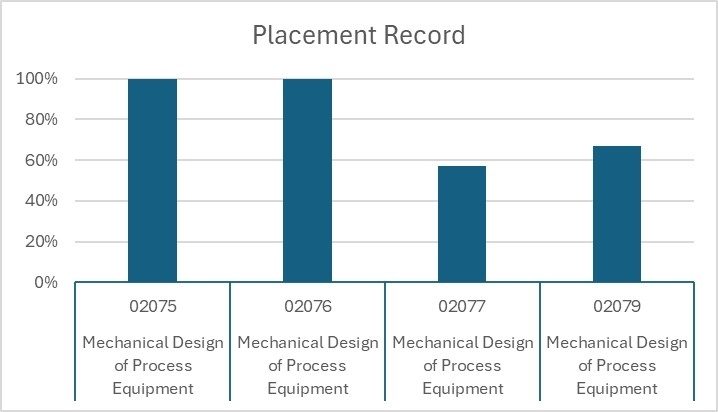
  • 100% Placement Assistance & Career Support
The Mechanical Design of Process Equipment course trains participants in the design of equipment used in Oil & Gas, Chemical, Petrochemical, Refinery and other process industries. The program covers design inputs from PFDs, P&IDs and data sheets, material selection, pressure part calculations as per ASME Section VIII Division 1, and the mechanical design of pressure vessels, reactors, heat exchangers, distillation columns, storage tanks and separators.

Participants learn to prepare Mechanical Data Sheets, GA drawings and Bills of Materials, understand fabrication, welding, NDT and testing requirements, and perform pressure vessel calculations using PV Elite software. The course also gives an overview of rotating equipment and piping, preparing Mechanical and Production engineers for design roles in EPC companies, consultancies and equipment manufacturing.

Fresh/ Experienced - Diploma/ Degree Mechanical / Production Engineers.

MODULE 1: Introduction to Process Equipment Design
  • Role and responsibilities of a Process Equipment Mechanical Designer.
  • Overview of Oil & Gas, Chemical, Petrochemical and Refinery industries.
  • Industry functioning and overview of plant layout (Plot Plan).
  • Introduction to process plants and their major facilities.
  • Basic process requirements of plants and projects.
  • Introduction to various types of process equipment.
  • Importance of engineering codes, standards and specifications.
  • Overview of ASME, TEMA, API, ASTM and other relevant standards.
MODULE 2: Engineering Documents and Design Inputs
  • Introduction to engineering documentation and its importance.
  • Study and interpretation of Process Flow Diagram (PFD).
  • Study and interpretation of Piping & Instrumentation Diagram (P&ID).
  • Understanding Process Data Sheets.
  • Mechanical Design Data Sheets.
  • Equipment specifications and technical requisitions.
  • Study of vendor drawings and vendor data.
  • Checking and verification of vendor documents.
  • Understanding design inputs, operating conditions and design conditions.
  • Coordination with Process, Piping, Civil, Instrumentation and other engineering departments.
MODULE 3: Material Selection and Material of Construction
  • Introduction to engineering materials used in process equipment.
  • Mechanical and chemical properties of materials.
  • Material selection based on process services.
  • Selection of materials for corrosive, high-temperature and low-temperature services.
  • Introduction to Carbon Steel, Stainless Steel, Alloy Steel and other special materials.
  • Corrosion allowance and its importance.
  • Material specifications and ASTM standards.
  • Material compatibility and limitations.
MODULE 4: Fundamentals of Pressure Vessel Design and Calculations
  • Introduction to pressure vessels and their classification.
  • Design pressure, operating pressure and design temperature.
  • Internal and external pressure considerations.
  • Basic pressure part calculations.
  • Calculation of shell thickness and head thickness.
  • Introduction to different types of vessel heads.
  • Nozzle reinforcement and opening calculations.
  • Introduction to stiffening rings and their applications.
  • Minimum Design Metal Temperature (MDMT).
  • Introduction to hydrostatic and pneumatic pressure testing.
  • Overview of ASME Section VIII Division 1.
MODULE 5: Mechanical Data Sheets, Drawings and Bill of Materials
  • Preparation of Mechanical Data Sheets for process equipment.
  • Understanding equipment design parameters and specifications.
  • Introduction to General Arrangement (GA) drawings.
  • Equipment fabrication drawings and sectional views.
  • Preparation and interpretation of equipment drawings.
  • Preparation of Bill of Materials (BOM) at different design stages.
  • Material take-off and quantity estimation.
  • Understanding equipment tags, dimensions and drawing references.
  • Revision control and engineering documentation.
MODULE 6: Process Equipment Components and Construction
  • Introduction to various components used in process equipment.
  • Shells, heads, nozzles, manholes and manway covers.
  • Flanges, gaskets, bolts and fasteners.
  • Supports, saddles, skirts and legs.
  • Internal components and external attachments.
  • Equipment fabrication and construction procedures.
  • Introduction to welding processes and welding terminology.
  • Welding procedures and WPS/PQR.
  • Welding inspection and quality control.
  • Introduction to Non-Destructive Testing (NDT).
  • Methods of testing: Hydrotest, Pneumatic Test and other inspection requirements.
MODULE 7: Mechanical Design of Process Equipment
  • Introduction to mechanical design of process equipment.
  • Design and construction of pressure vessels.
  • Mechanical design of reactors.
  • Mechanical design of heat exchangers.
  • Introduction to TEMA standards and heat exchanger components.
  • Mechanical design considerations for distillation columns.
  • Introduction to storage tanks and separators.
  • Design considerations for different process services.
  • Overview of equipment drawings and design calculations.
  • Introduction to equipment fabrication requirements.
MODULE 8: Equipment Accessories and Special Design Considerations
  • Overview of equipment-mounted accessories and instrumentation.
  • Introduction to drip pipes, drain and vent connections.
  • Instrument connections and temperature/pressure sensors.
  • Lifting lugs and trunnions.
  • Platforms, ladders and access arrangements.
  • Insulation and cladding requirements.
  • Equipment nozzles and piping interfaces.
  • Introduction to chimney and stack design.
  • Basic design considerations for chimneys.
  • Equipment maintenance and accessibility requirements.
MODULE 9: Process Equipment Design Software – PV Elite
  • Introduction to process equipment design software.
  • Overview of PV Elite software.
  • Understanding software interface and basic functionalities.
  • Creation of equipment models.
  • Input of design parameters and material properties.
  • Basic shell, head and nozzle modelling.
  • Performing basic pressure vessel design calculations.
  • Understanding software calculation reports.
  • Introduction to design verification and code compliance.
  • Interpretation of software-generated results.
MODULE 10: Overview of Rotating Equipment and Piping
A. Rotating Equipment
  • Introduction to rotating equipment used in process plants.
  • Types of pumps, compressors, turbines and blowers.
  • Basic working principles and applications.
  • Major components and construction overview.
  • Introduction to equipment data sheets and specifications.
  • Basic equipment selection considerations.
B. Piping Engineering
  • Introduction to piping systems in process plants.
  • Types of pipes, fittings, flanges and valves.
  • Introduction to piping materials and specifications.
  • Overview of piping layouts and isometric drawings.
  • Understanding piping connections with process equipment.
  • Introduction to piping supports and accessories.
  • Overview of piping stress and equipment nozzle loads.
  • Coordination between piping and equipment design departments
  • To develop an understanding of the mechanical design of process equipment used in Oil & Gas, Chemical, Petrochemical, Refinery and other process industries, covering engineering fundamentals, design inputs, material selection, pressure part calculations, equipment drawings, fabrication, inspection and industry-standard design software.

Enquiry Form

Mechanical Design of Process Equipment

FAQ's

What is the Mechanical Design of Process Equipment?
The Mechanical Design of Process Equipment course focuses on the principles and techniques involved in designing various types of process equipment used in industries such as chemical, oil and gas, pharmaceuticals, food and beverage, and more. It covers topics like pressure vessel design, heat exchanger design, storage tank design, piping design, and mechanical integrity.
What are the career prospects for professionals with expertise in Mechanical Design of Process Equipment?
Professionals with expertise in Mechanical Design of Process Equipment have various career opportunities in industries involved in process equipment manufacturing, plant engineering, construction, and maintenance. They can work as mechanical design engineers, equipment engineers, project engineers, consultants, or in related roles.
What job opportunities are available for professionals specializing in Mechanical Design of Process Equipment?
Professionals specializing in the Mechanical Design of Process Equipment have job opportunities in industries such as chemical, oil and gas, pharmaceuticals, food and beverage, and more. Some common job roles include mechanical design engineer, equipment engineer, process engineer, project engineer, consultant, and design coordinator.
How is the job market for professionals specializing in Mechanical Design of Process Equipment?
The job market for professionals specializing in Mechanical Design of Process Equipment can vary based on factors such as industry demand, economic conditions, and geographical location. However, there is generally a demand for skilled professionals in this field, particularly in industries that rely heavily on process equipment.
Are there any placement assistance services provided by SIT?
We have a dedicated Placement cell which continuously seeks for employment opportunities and arranges On-Campus as well as Off-Campus recruitment activities. The institute assists students to enter in their respective industries by providing 100% Placement assistance. The Placement Cell conducts Mock Interviews of students for their preparation for final interviews in the industry.

Testimonials