
MEP Course Eligibility: Can Freshers Join?
Enquiry Now
Starting a career in engineering can feel a bit rough for fresh graduates, especially when you are trying to move from bookish theory into something more practical, like what actually happens on site. One area that people often overlook is MEP engineering; it has a key role in today’s construction, infrastructure, and all those building services that keep everything running smoothly.
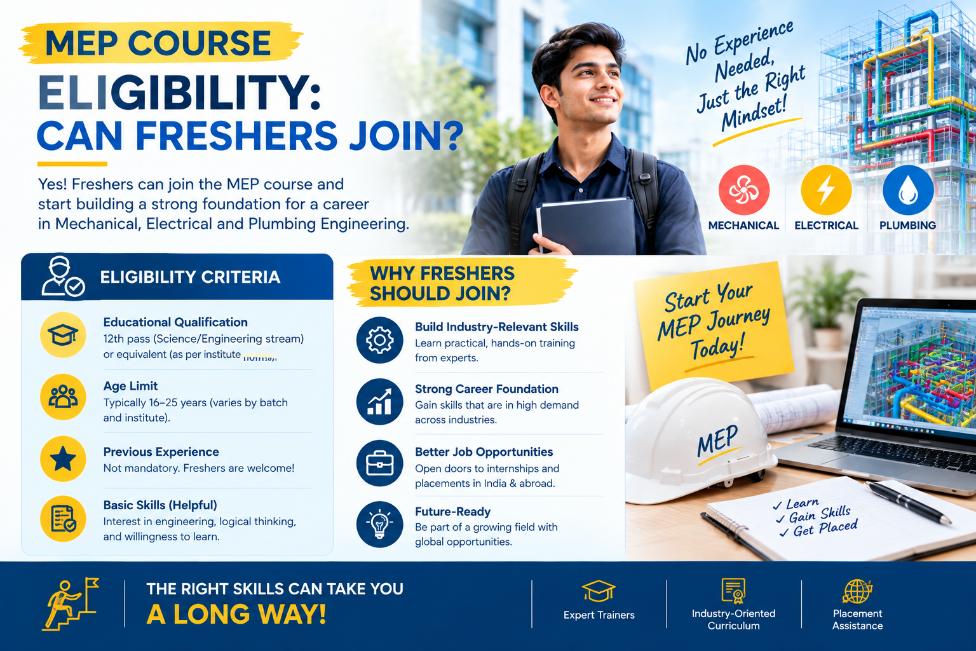
So, can freshers actually join an MEP course without prior work experience? Mostly, yes. As long as you qualify for the educational eligibility rules of the programme. An MEP online course, or a specialised engineering training plan, can help eligible learners get a solid grip on mechanical, electrical, and plumbing systems, and also gear up for entry-level openings.
Suvidya Institute of Technology provides MEP Engineering training for fresh and experienced mechanical, production and electrical engineers. The course goes through essential building services plus hands-on engineering thinking, so learners can align themselves with what the industry usually expects.
What Is an MEP Course?
MEP means Mechanical, Electrical, and Plumbing. These systems are basically what makes residential, commercial, and industrial buildings operate safely , efficiently, and comfortably.
A MEP course usually covers design, planning, coordination, and installation rules for these systems. Depending on the curriculum, students get exposure to HVAC systems, electrical distribution, plumbing networks, fire protection, and building management systems.
Overall, the training supports engineering graduates to understand how the different building services connect together, not only during construction, but also across a building’s entire working life.
Who Is Eligible to Join an MEP Course?
Eligibility depends on the institute and the exact programme structure. At Suvidya Institute of Technology , the MEP Engineering course is meant for fresh and experienced engineers from these disciplines :
- Mechanical Engineering: ideal for graduates who want to learn about HVAC, air conditioning, ventilation, and other mechanical building services.
- Electrical Engineering: for candidates focused on electrical layouts, power distribution, lighting layouts, and electrical equipment.
- Production Engineering: a good choice for eligible graduates who want a more specialised engineering lens, with exposure to building services.
Before you enroll, it’s best to verify your educational credentials and the current admission requirements directly with the institute.
Can Freshers Join an MEP Online Course?
Yes, freshers can join an MEP training programme if they meet the eligibility conditions. Prior employment is not always mandatory, because these programmes are built to support learners and extend beyond the usual degree syllabus.
For fresh graduates, an MEP course can act like a clear pathway into real-world engineering usage. It helps connect what you studied in classrooms with how construction and engineering projects are actually executed.
That said, don’t mix up an online course with a classroom-based programme. Before you register, check the learning format, practical training options, software exposure, and whether project work is included. These details can really decide how job-ready you become, in a practical sense.
What Will Freshers Learn During MEP Training?
A solid MEP programme typically covers several building services engineering areas, like :
1. HVAC System Design
You study heating, ventilation, and air conditioning fundamentals. This can include heat load calculations, air distribution, ducting, chilled water systems, and newer air conditioning methods.
2. Electrical System Design
This module covers electrical distribution, cables, transformers, circuit protection, lighting layouts, earthing, and electrical load calculations. Learners understand the electrical backbone needed for buildings.
3. Plumbing System Design
Here you learn about water distribution, drainage, plumbing fixtures, water demand calculations, sewage systems, and water recycling topics.
4. Fire Alarm and Protection Systems
Fire safety training may cover fire alarm systems, sprinkler arrangements, hydrant systems, smoke detectors, and related design expectations.
5. Building Management Systems
Students are introduced to BMS , which helps monitor and manage building services, equipment operations, and energy use.
Depending on the programme, students may also learn bills of quantities (BOQ), design basis reports (DBR), engineering documentation, and the relevant industry standards.
What Skills Do Freshers Need Before Joining?
Freshers don’t always need professional work experience, but some skills can make everything feel easier from day one.
A basic understanding of engineering mathematics, physics, technical drawings, and fundamental engineering concepts helps. If a programme includes computer-aided design, then familiarity with CAD software can be useful too , though the exact level varies by course.
Also, you should be open to learning technical concepts, reading drawings properly, solving engineering problems, and working across multiple disciplines. Communication and teamwork matter as well, because MEP engineers usually coordinate with architects, contractors, consultants, and other engineering groups.
Most importantly, freshers should enter the course with a practical mind-set, and a real willingness to grow their technical capabilities.
Career Opportunities After Completing an MEP Course
Once you complete your MEP training, you can explore entry-level roles based on your qualifications, skills, and what employers are asking for.
Potential career paths include:
- MEP Design Engineer: Supports the preparation and coordination of building services designs.
- HVAC Design Engineer: Works on air conditioning, ventilation, and cooling system design.
- Electrical Design Engineer: Assists with electrical layouts, load calculations, and power distribution planning.
- Plumbing Design Engineer: Supports water supply, drainage, and plumbing system design.
- MEP Drafter: Prepares technical drawings and layouts using relevant drafting software.
- MEP Project Engineer: Assists with project coordination, documentation, installation, and execution activities.
Completing a course does not guarantee employment. Practical competence, software knowledge, interview preparation, and the availability of suitable vacancies also influence career outcomes.
Why Choose Suvidya Institute of Technology for MEP Training?
Choosing the right training institute is an important step for fresh engineering graduates. Suvidya Institute of Technology offers specialised MEP Engineering training that introduces learners to HVAC, electrical, plumbing, fire protection, and related building services.
The programme highlights practical learning, engineering project exposure, industry practices, and guidance for career development. The institute also states that it provides placement assistance to help students explore employment opportunities.
Freshers should review the current syllabus, batch schedule, course duration, learning format, and admission conditions before making a decision.
Learn more about the programme on the MEP Engineering course page.
Conclusion
Freshers can build a foundation for a career in building services engineering through specialised MEP training, provided they meet the programme’s eligibility requirements. The right course can help engineering graduates understand HVAC, electrical, plumbing, fire protection, and building management systems while developing practical knowledge relevant to construction projects.
If you have completed a mechanical, production, or electrical engineering qualification, consider exploring an MEP online course or another suitable training format to strengthen your technical skills. Contact Suvidya Institute of Technology to confirm your eligibility, understand the available course options, and identify the training pathway that best matches your career goals.


