
Skills Required to Start a Career in Piping Engineering
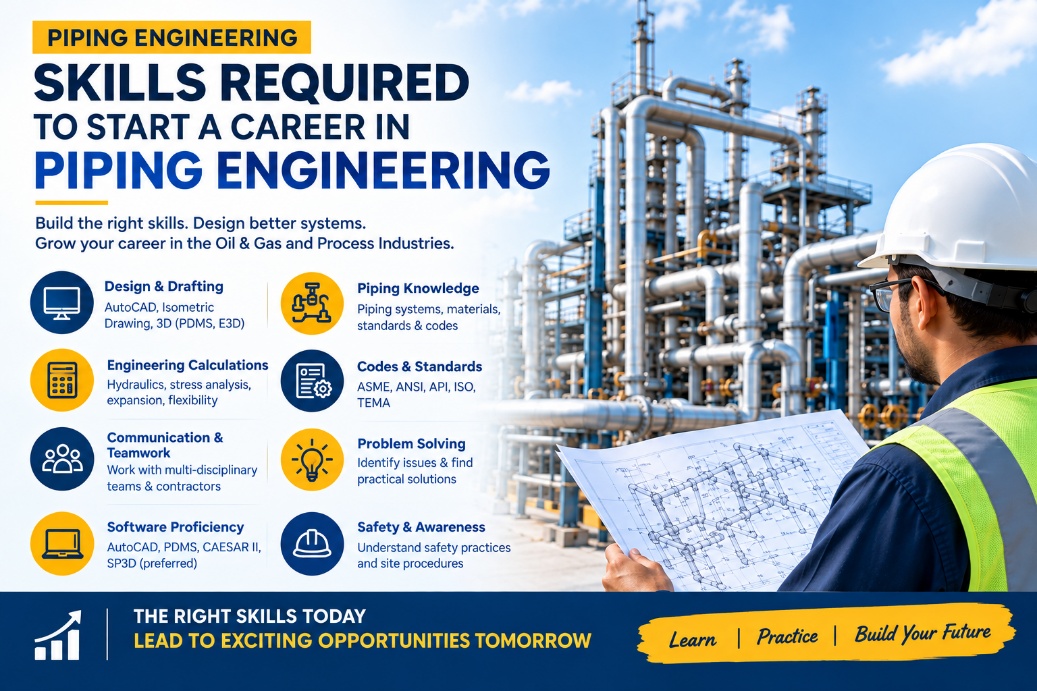
Enquiry Now
Taking up projects in the piping engineering area is a wise career choice for all the engineering students and diploma holders who want to join the areas of oil and gas, petrochemicals, chemicals, and process plants.
Nevertheless, it is imperative to note that merely being an engineering graduate does not mean one becomes a piping engineer. It takes a mix of engineering, design, computer expertise, attention to detail, and knowledge on how the piping systems in industries work.
It is extremely important to know what it means to become a good piping engineer.
What Is the Responsibility of a Piping Engineer?
Piping engineers have to deal with the pipes that connect different machines and transport fluids inside the process plant. This can range from pipe designing to pipes’ materials and the equipment-pipe connection. Other responsibilities include piping stresses and flexibility.
The job of a piping engineer is much more than production drawings.
Sometimes, it will involve collaborating with other disciplines including process engineers, mechanical engineers, equipment engineers, civil engineers, structural engineers, electrical engineers, and instrumentation engineers.
1. Basic Engineering Knowledge
The most important thing that one should know before venturing into the field of piping engineering is knowledge on basic engineering concepts.
These include:
- Engineering drawings
- Piping components
- Valves and fittings
- Equipment
- Piping materials
- Plant layout
- Pipe supports
- P&ID drawings
- Isometric drawings
- Code/standards
Which help one understand the reason behind the design of a piping system rather than just drawing it.
2. Piping Components Awareness
Piping systems consist of other components apart from piping itself. A piping engineer should know about valves, fittings, flanges, gaskets, reducers, tees, elbows, branches, and supports.
One should know about their function, applications, and how these components interact with other system components.
For example, just placing a valve on a drawing does not do. Location, access, orientation and interaction with other piping parts may be crucial in a real plant setting.
3. Reading P&IDs
P&ID refers to Piping and Instrumentation Diagrams which are very significant documents in process plant engineering field.
The ability to read a P&ID and get information about equipment, piping, valves, instruments, direction of flow, connections and process interaction is necessary for a piping engineer.
Reading a P&ID is the way to understand how the process should work before starting the physical plant layout design.
4. Piping Layout
And one more topic that deserves attention here is the issue of piping layout.
It is necessary for a piping engineer to know how to route piping around the equipment having in mind the access, operational, maintenance, safety and constructional considerations.
It is not sufficient for a piping engineer to provide a layout where all piping would fit in the available space. Piping should be in interaction with equipment, structures, platforms, supports and other facility items.
5. Codes and Standards
Engineering codes, standards and specifications are used when designing piping systems.
There is no necessity to memorize them all at once. But it is important to realize their significance and know how to use them.
The more you work, the more familiar you will get with codes and specifications for your own projects.
6. Knowledge of Piping Engineering Design and Drafting
While the knowledge of piping engineering covers a wider scope compared to piping design, the understanding of both design and drafting remains significant.
You should be able to understand:
- Piping designs
- Isometrics
- Equipment layout
- Pipe rack layout
- Plot plans
- Construction drawings
- Bill of materials
The ability to interpret drawings can make it easier for you to communicate your engineering needs and identify problems within the project.
7. Computer Skills
In today’s piping engineering, the use of computer applications is required.
According to the job description, the following computer applications might come handy:
- AutoCAD
- E3D
- CAESAR II
- Plant Design and Engineering Software
The computer software can never substitute for your engineering skills. Working with the software is just one part of the whole process. You need to understand what you are designing or analyzing.
Example – The Piping Engineering course offered by Suvidya covers the use of E3D and CAESAR II software, besides the basics of piping engineering.
8. Awareness of Pipe Support and Stress
Pipe support plays an important role in the piping system. The piping engineer should understand the importance of pipe support and its impact on the system.
It would also be helpful to know a bit about the stress and flexibility of piping systems. Pipes in the system experience movement due to change in temperatures and other operating conditions.
While it is not always necessary to know about stress analysis for every piping engineer, knowledge in this field will help you make the right routing decisions.
9. Problem Solving & Attention To Detail
The pipelining project is restricted by several elements such as space constraint, equipment limitations, conflict, support system, among others.
Thus, the piping engineer must have the ability to solve and provide solutions to problems.
In addition to this, paying attention to detail is highly essential. The smallest mistake in drawings, size, specification, connection, etc. could create big trouble at the future stage of the project.
10. Good Communication & Teamwork
Piping engineer is not supposed to work alone.
They work in coordination with process engineers, mechanical engineers, equipment engineers, civil/structural engineers and designer/constructor team.
Therefore, the individual should have the ability to express technical problems effectively, understand information from other disciplines, and also communicate change in design.
11. Practical Understanding of the Industry
One of the key differences between academic knowledge and professional practice is practical understanding.
Knowledge of the definition of valve and how to draw a CAD drawing does not mean at all that one understands how this information is used in reality.
Assignments, case studies, project work and industry-based training can be used as means of reducing this gap.
Technical Training of Suvidya Institute of Technology is oriented to engineering in the field of oil and gas, petrochemical and process chemical plants.
Picking up a Piping Course in Mumbai
When looking for a piping course in Mumbai, you have to choose an appropriate program considering not only the name of the course.
Look at the curriculum and make sure that it includes engineering basics, piping components, P&IDs, piping layout, drawings, codes and standards, software and assignments.
Technical training in oil and gas, petrochemical and process chemical plants engineering is performed by Suvidya Institute of Technology.
Founded in 2002, Suvidya Institute of Technology provides training courses in various branches of engineering.
Courses offered at Suvidya Institute of Technology include Piping Engineering, Piping Design & Drafting, and other advanced engineering courses.
What should you learn first?
If you are a beginner in piping engineering and attempting to learn everything at once, it may create complications for you.
Right order of learning can be:
First: Basic engineering and pipe parts.
Second: P&ID, pipe arrangement, and engineering drawing.
Third: Material, support, code, and standard.
Fourth: Software according to your professional requirement.
Fifth: Assignments and projects.
In this way, you would be able to build your engineering fundamentals without having dependency on software.
Conclusion
Being a professional in piping engineering doesn’t require a degree in engineering or knowing about particular software application.
This requires a blend of engineering fundamentals, knowledge about piping, sketching, software application, problem solving skills, attention to details, and practical job knowledge.
If you are a student or professional looking forward to taking piping engineering training in Mumbai, then choosing a training course with both technical and software training will serve you well.
Suvidya Institute of Technology provides Piping Engineering Training.


