
What Skills Does an Electrical Design Engineer Actually Need?
Enquiry Now
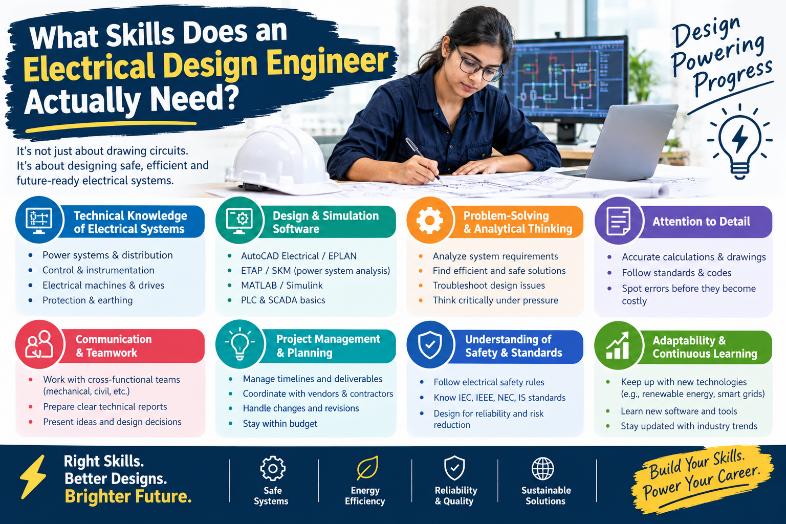
Every building, plant, or industrial facility runs on power somewhere underneath its surface — wiring, panels, switchgear, control systems, all planned out before a single cable gets pulled. That planning is what an electrical design engineer does, and it takes more than just knowing Ohm’s Law to do it well.
If you’re considering this path, or you already have a basic electrical background and want to shift into design work specifically, here’s a rundown of what actually matters in this field.
Strong Grip on Electrical Fundamentals
Sounds obvious, but worth saying anyway. Power systems, electrical machines, control systems, instrumentation — a design engineer needs to actually understand how these things interact, not just recall formulas from a textbook. Design work means applying concepts to real, physical systems, and mistakes there have real consequences. It’s not an exam anymore.
Reading and Creating Technical Drawings
Electrical design basically lives on drawings. Single line diagrams, panel layouts, cable routing plans, schematics — you need to read these correctly and produce your own without someone hand-holding you through it. An engineer who struggles to turn an idea into a clean, standard-compliant drawing is going to hit a ceiling fast, no matter how solid their theory is.
Knowledge of Codes and International Standards
This one trips up a lot of freshers. Electrical design has to follow codes and standards that vary by project and region, and getting this wrong isn’t some minor slip. It can mean rework, safety problems, delayed timelines. A competent design engineer knows these codes well enough that they’re not constantly flipping through a manual mid-project.
Familiarity with Automation and Control Systems
Electrical design rarely stays limited to just power distribution anymore. Automation and control systems show up in nearly every project now — industrial plants, large commercial buildings, doesn’t matter. Knowing how control systems and instrumentation tie into electrical design has become part of the basic job description, not some bonus skill.
Basic Understanding of Power Electronics and Digital Signal Processing
Depending on what kind of projects come your way, some grounding in power electronics and digital signal processing goes a long way. These pop up more in specialized industrial or telecom-related electrical work, and even a working knowledge here puts you ahead of someone who’s only ever touched basic power systems.
Software and Design Tool Proficiency
Manual calculations still have their place, but almost everything on a real project runs through design software these days. Companies expect you to already know your way around the tools used for layout, load calculations, and drawing production. Nobody’s training you on this from scratch anymore — that’s assumed knowledge walking in.
Understanding Project Deliverables
Not something people talk about much when discussing this job. But there’s a real gap between knowing your subject and knowing what a project actually wants from you — the format, the deadline, the exact deliverable expected. Engineers who get this part usually settle into EPC project teams a lot quicker than the ones who only bring technical knowledge to the table.
Communication and Coordination Skills
Nobody designs electrical systems in a bubble. Mechanical teams, piping teams, structural teams — they’re all in the mix on any real project, and half the delays that happen come down to people not talking to each other properly. If you can explain your design decisions without overcomplicating things, coordinate across teams, and hold your own in a meeting, that alone puts you ahead of a lot of engineers stuck purely in technical mode.
Discipline and Attention to Detail
One missed detail on an electrical drawing, and construction can run into real trouble later. This is why the field tends to favor people who check their own work twice, who don’t treat documentation as some boring formality, and who just pay attention properly the first time around.
Why Structured Training Helps Build These Skills Faster
A lot of this can technically be picked up on the job, sure. But that route takes years, and usually a fair number of costly mistakes along the way too. A structured electrical system design course cuts that learning curve down significantly. Decent programs cover power systems, control and automation, instrumentation, power electronics, and current codes, while also giving you a feel for how EPC companies actually operate day to day.
What separates an average course from a genuinely useful one usually comes down to practical exposure. Programs built around real project-style assignments, taught by people who’ve actually worked in the field, tend to produce engineers who aren’t completely lost on their first day of work.
Career Paths This Opens Up
Once these skills come together, electrical design engineers usually land roles in power system design, panel and switchgear design, control and automation design, cable routing and layout planning, or instrumentation-related electrical work. These roles aren’t limited to one sector either — oil & gas, manufacturing, construction, infrastructure projects, they all need electrical design support in one form or another.
Final Thoughts
Becoming a capable electrical design engineer isn’t about being exceptional at one single thing. It’s about pulling together technical knowledge, drawing skills, code awareness, and communication into something a project team can actually depend on. If this path interests you, building these skills together — ideally through structured training with real project exposure — tends to get you job-ready far quicker than trying to figure it all out on your own, piece by piece.


