
Engineering Design and Drafting Course in Mumbai: Skills, Syllabus and Career Opportunities
Enquiry Now
There are several engineering, construction, manufacturing, infrastructure, consulting, and industrial companies located in and around Mumbai. Given the diverse presence of several technical industries in the area, there are several fields that a student may choose from if he or she wants to focus on design and drafting.
The engineering design and drafting course is a perfect example of a study which combines the theoretical aspect of technical knowledge and practical project work. By taking an Engineering Design and Drafting Course in Mumbai, a student can become familiar with the instruments, concepts, drawings and documentation used in engineering projects.
The student who wants to get experience in such areas as CAD, mechanical drawing, piping, structural design, electrical systems, instrumentation and HVAC can benefit from this type of course as it provides the opportunity of getting familiar with several disciplines instead of focusing on only one particular area.
Suvidya Institute of Technology offers one-year full-time HVAC course in mumbai including mechanical engineering drawing, piping and process drafting, electrical and
instrumentation drafting, civil and structural drafting, HVAC and mechanical static drafting, AutoCAD, workplace safety, engineering interfaces, and communication skills.
What Does Engineering Design and Drafting Involve?
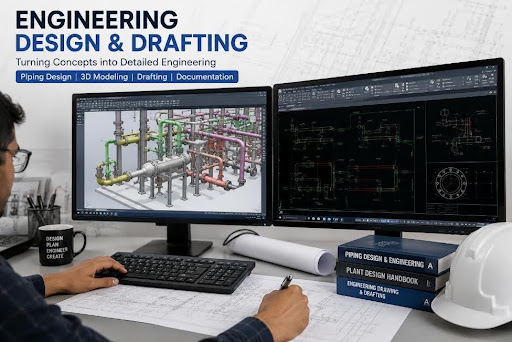
Engineering design and drafting involve making technical drawings and plans, which should communicate engineering designs, manufacturing, fabrication, or installation of engineering components, systems, structures, or facilities.
Though a drawing may seem simple to a person who does not know anything about engineering, it can include a lot of technical information. It may include information about dimensions, symbols, materials, location of equipment, components, specifications, installation, etc. Such drawings are used by professionals during different phases of a project.
For example:
An engineer may use a drawing to communicate design concepts. Fabricator uses them for manufacturing or assembly of components. A construction crew uses them to understand installation requirements. A procurement department uses specification and material information. Thus, engineering drafting becomes an important part of
engineering communication.
Why Should You Opt for Engineering Design and Drafting in Mumbai?
Opting for an Engineering Design and Drafting Course in Mumbai may be beneficial for those interested in studying in a city with a diverse industrial and professional environment.
Mumbai and the region have industries engaged in construction, manufacturing, infrastructure, engineering services, real estate, industrial projects, and consulting. Also, the exposure to the professional environment where technical skills are applicable to various industries would be advantageous for students. Nevertheless, the choice of institution should not only be based on its location.
One should take into consideration the curriculum of the program, practical exposure, faculty, software training, industry orientation, and career opportunities offered by the institution.
Understand the Structure of the Program
A good drafting program goes beyond the basics of CAD commands. In addition, students should get an idea about
how the drawings are linked to engineering projects. The program at Suvidya School of Engineering and
Technology includes several modules giving the students experience in various engineering disciplines.
Mechanical Engineering Drawing and AutoCAD
The program includes Mechanical Engineering Drawing with the use of AutoCAD. AutoCAD is the popular
computer-aided design software that gives professionals the opportunity to create technical drawings. However,
besides the basics of CAD, students need to know how to interpret drawings and understand the underlying
engineering concepts.
Piping and Process Drafting
Piping is an integral element of many industrial and process facilities. The program will give an idea about
what piping deliverables include and how they are documented in projects, such as piping code and standards,
plot plans, equipment layout, piping layout, pipe support layout, nozzle orientation, construction isometrics,
as-built drawings, and material take-offs.
Electrical and Instrumentation Drafting
Electrical and instrumentation are also important elements of engineering projects. The program includes basics
of electrical system design, single line diagram, bills of materials, instrumentation, hook-up diagrams, and
international codes and standards.
Civil and Structural Drafting
Technical drawings are needed in order to fabricate, construct and install structures. Students in the program
get exposed to steel sections, structural support drawings, foundation drawings, road plans, trench drawings,
dyke wall drawings, as-built drawings, material take-offs, and structural elements. This could be quite helpful
for students who are interested in civil structures and infrastructure works.
HVAC and Mechanical Static Drafting
Technical drawings are required for HVAC systems in order to design equipment, duct, piping, support and
installation thereof. This includes duct layouts, equipment layouts, chilled water and cooling water piping
layout, pipe supports, construction isometrics, as-built drawings, material take-offs.
Who Can Join?
What stands out as one of the key points of the course is its admission policy. Suvidya currently admits
candidates having HSC and 50% in Science, Commerce, Arts, or MCVC. This means that the program does not have
admission restrictions based on only one particular HSC stream. However, students should consider if they have
an interest in technical subjects, drawing, computer drawing design, mathematics, problem-solving and
engineering.
Is an Engineering Degree Necessary?
This is one of the typical questions raised by students seeking to pursue a career in drafting. Engineering
drafting and an engineering degree program are different things. An engineering degree usually involves a
significant amount of theoretical and mathematical education in the chosen engineering field. A drafting program
can focus on technical drawings, CAD, engineering drawings and deliverables, etc.
Depending on career goals, some students might find an Engineering Design and Drafting Course in Mumbai more
interesting.
What Skills Can You Acquire?
There are many skills that you can gain from attending a drafting course.
Technical Skills
Drawing preparation, CAD, layouts, engineering documentation, and project deliverables are a few examples of
such skills.
Analytical Skills
Students should be able to understand technical data and how various components fit together.
Visualization Skills
Being able to picture how two-dimensional drawings represent actual objects, systems, and structures is an
important skill for engineering draftsmanship.
Problem-Solving Skills
Sometimes drafting includes being able to recognize constraints, solve drawing issues, and present technical data
in an understandable way.
Communication Skills
It is necessary to work with several departments at once.
At Suvidya, personality development and communications training are included in the course curriculum.
Career Paths after the Course
There are several technical career options that students who attended an Engineering Design and Drafting Course
in Mumbai could pursue.
They could become:
- CAD Technician
- CAD Drafter
- Engineering Drafter
- Engineering Designer
- Design Engineer
- Product Development Specialist
- Piping Drafter
- Structural Drafter
- Mechanical Drafter
Some of the possible career paths mentioned by Suvidya in their course FAQs are CAD technicians, drafters,
engineering designers, design engineers, and product development specialists.
Industries where they could work include manufacturing, construction, engineering consultancy, product
development, architecture-related activities, and industrial projects.
Industry Exposure
Classroom theoretical knowledge gets more meaning when students comprehend how it applies to professional tasks.
According to Suvidya, students gain exposure to the working culture of Engineering, Procurement and Construction
firms and learn about their project activities and deliverables.
Also, the institute notes the importance of knowledge of modern engineering practices and international codes
and standards.
Such an industry-oriented approach could be useful for understanding that professional drawing entails much more
than using computer-aided design tools to draw lines.
Placement Assistance in Mumbai
After students complete a course, one of the main questions they ask is how to find employment. According to
Suvidya, it has a placement cell which is trying to seek employment opportunities and conduct on-campus and
off-campus recruitment. Also, it offers mock interviews to prepare students for real-life interview process in
the industry. This approach is called 100% placement assistance by Suvidya institute.
It should be noted that there is a difference between placement assistance and guarantee of employment.
Assistance may involve recruitment efforts and training, while employment is possible only depending on
individual skills and performance, requirements of an employer, and employment opportunities.
Why Choose Suvidya Institute of Technology?
While choosing an Engineering Design and Drafting Course in Mumbai, students should compare various options.
According to Suvidya, its course combines technical drafting and exposure to several engineering departments.
Its curriculum includes mechanical drawing, piping/process, electrical/instrumentation, civil/structural, and
HVAC/mechanical static drafting. Also, it covers AutoCAD, workplace HSE awareness, interfaces with engineering
departments, personality development, and communication skills. Currently, this course is advertised as a one
year full time course.
Conclusion
An Engineering Design and Drafting Course in Mumbai could be an interesting option for students who are willing
to master practical technical skills and discover career paths related to CAD, engineering drawings,
industrial projects, and design. This field combines technology and engineering knowledge and communication.
Instead of concentrating only on technical aspects of learning computer-aided design software, students could
benefit from understanding how drawings are used in practice, how different engineering departments work
together and how technical information flows from design to manufacturing and installation phases.
In case you are considering studying engineering drafting or CAD-related design, investigating various
institutes’ curriculum, practical exposure, eligibility criteria, course duration, industry orientation and
placement assistance could be helpful.


