
The Blueprint of Modern Infrastructure:
Understanding MEP Engineering
Enquiry Now
Why MEP Engineering Is Really Important
When you look at a building you usually notice the architecture. You see the glass façade, the height of the building or the shape of the building itself. What you do not see are the systems inside the building that make it usable.
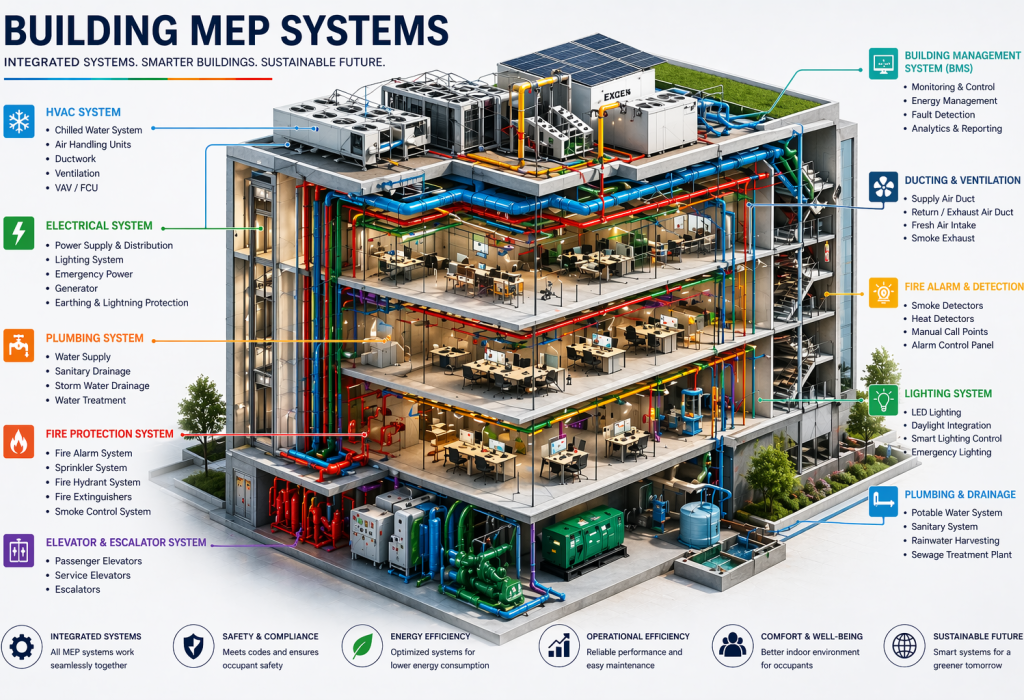
Things like air circulation, electricity, water supply, drainage and fire protection are not visible from the outside. They are essential for the building to function.
This is where MEP engineering comes in.
MEP engineering is short for Mechanical, Electrical and Plumbing engineering. These three disciplines work together to make buildings safe, comfortable and functional. Without MEP engineering even the impressive building would be an empty shell.
As cities grow and buildings become more complex these systems are becoming moresophisticated. This has increased the demand for engineers who understand how these systems work together.
What an MEP Engineer Actually Does
At its core the role of an MEP engineer is coordination. Designing one system is relatively straightforward. When several systems need to share the same space it becomes a challenge.
An MEP engineer typically works on tasks such as designing HVAC systems that maintain temperature and ventilation, planning electrical distribution and lighting layouts and developing plumbing systems for water supply and drainage. They also coordinate these systems with structural drawings.
In practice coordination is critical. A duct cannot pass through a beam. A pipe cannot occupy the same space as a cable tray. MEP engineers must resolve these conflicts during the design stage long before construction begins.
The Need for Training
Most engineering graduates learn the theory behind mechanical or electrical systemsduring their degree programs. Real engineering projects involve more than theory.
Engineers must understand project documentation, design deliverables and the workflow used by engineering firms.
This is why many graduates look for training programs after completing their degrees.
For example engineers interested in building services design often explore programs such as the MEP Engineering Course at Suvidya Institute of Technology:
Many mechanical engineering graduates discover the field when searching online for an MEP course after engineering, especially if they want to move into construction or infrastructure projects.
Mechanical Systems: HVAC
The mechanical component of MEP engineering mainly focuses on HVAC systems: heating,
ventilation and air conditioning.
These systems are responsible for maintaining comfort. Engineers calculate cooling loads,design duct networks and select equipment such as chillers or air-handling units.
In commercial buildings HVAC systems can become complex. MEP engineers must balance comfort, energy efficiency and space limitations while designing these systems.
Electrical Systems in Buildings
Electrical engineering within MEP engineering involves more than providing power.
MEP engineers design the electrical distribution system of a building. This includes panel
Plumbing and Fire Protection
Plumbing systems manage water supply, drainage and sanitation inside buildings. Proper
design ensures that water pressure remains stable and that wastewater is removed efficiently.
Fire protection systems are also designed as part of the MEP engineering scope. These
systems include sprinklers, hydrants and alarm networks that help protect people and property.
Because of safety regulations these systems must follow engineering standards.
Career Opportunities in MEP Engineering
Engineers who specialize in MEP design can find opportunities in several sectors.
Typical industries include construction companies, engineering consultancies,
infrastructure development projects and EPC companies.
Entry-level roles often include positions such as MEP engineer or HVAC design engineer.
With experience engineers can move into project management or consulting roles.
Skills Modern MEP Engineers Need
Technical knowledge is important, but modern engineering design also relies heavily on digital tools.
Many engineers use software such as AutoCAD, Revit or other building information
modeling platforms. These tools allow engineers to create digital models of buildings before construction begins.
Another area that is becoming important is sustainable design. Engineers today often need
to consider energy efficiency and environmental standards when designing building systems.
The Future of MEP Engineering
The field of building services engineering is evolving quickly.
Many buildings are now designed as smart buildings, where sensors and automated
systems monitor energy usage, adjust temperature settings or detect maintenance issues
before they become serious problems.
As these technologies become more common engineers with an understanding of both
traditional building systems and digital technologies will have an advantage.
Although MEP systems are rarely visible they play a crucial role in modern buildings. From
air circulation to electrical supply and water management these systems ensure that
buildings remain safe and functional.
For engineers interested in construction or infrastructure projects learning how these
systems are designed can open the door to many career opportunities.
Programs that focus on practical engineering workflows can help bridge the gap between
academic theory and professional design work


